Returning users: Log in to continue or complete your application
The Georgetown McDonough MBA challenges students to think critically, lead ethically, and collaborate across disciplines. A new core curriculum emphasizes ethical decision-making, data and AI fluency, and leadership power skills development to align with recruiting timelines and the evolving demands of global business. Students personalize their studies through specialized electives and experiential learning opportunities, building advanced skills to compete and succeed in the global marketplace.
All Georgetown Full-time MBA students start with a core curriculum in finance, marketing, strategy, data analytics and AI, operations, economics, and management. They learn within a close-knit cohort of about 50–70 peers, building strong professional connections. Students then personalize their MBA by choosing career-aligned core and elective options that support career pathways while also building expertise in the fields of the future, such as AI, sustainability, healthcare, policy, and global business.
Opportunities such as Intensive Learning Experiences, the Ethics Project, the Global Business Experience, and the signature Executive Challenge provide real-world, hands-on learning. These experiences connect academic knowledge with practical, career-focused applications, preparing students to solve complex business challenges and lead effectively in global settings.
New Full-time MBA Curriculum
The Full-time MBA curriculum has been aligned with the future of work and emphasizes early leadership development, data and AI fluency, a strong global and ethics component, and greater personalization. The curriculum is scheduled to launch in fall 2026.
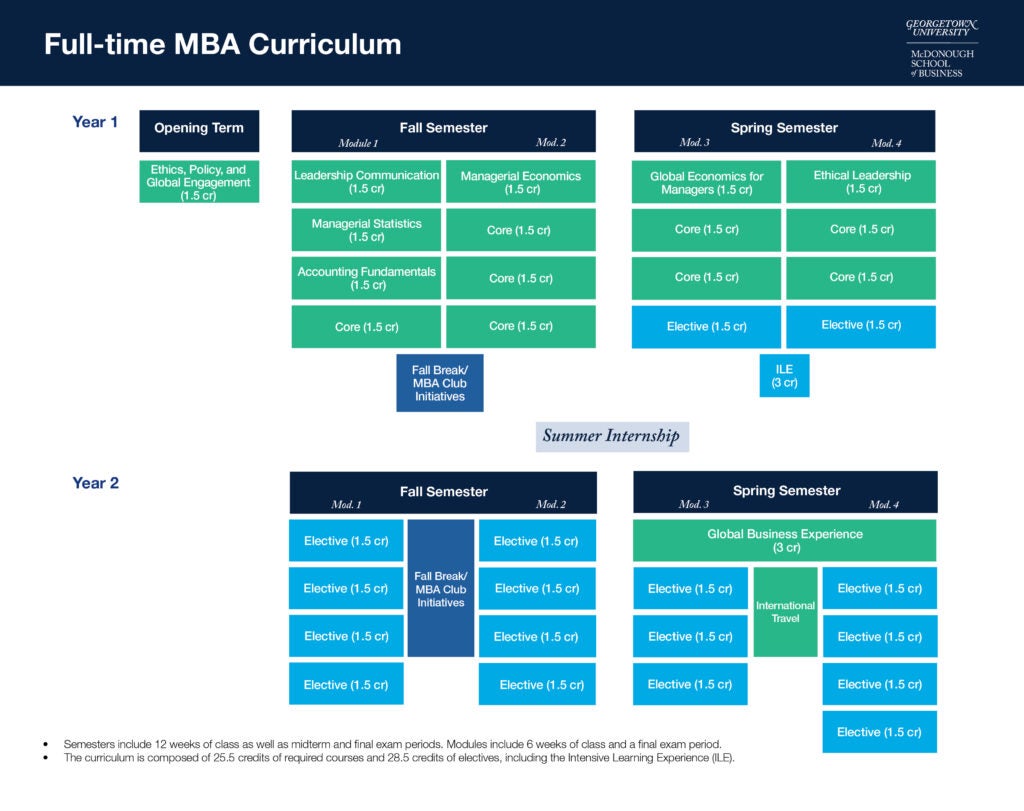
Please note that the curriculum is subject to change. Current students should refer to MyHoyaMBA for their class’s curriculum maps.
STEM-Designated Management Science Major
The Georgetown MBA offers a variety of coursework focused on quantitative analysis, AI and data analytics, and management science, allowing you to complete a STEM-designated management science major. You must complete a portion of your core and elective credits during the MBA program from a designated list to earn the designation.
Opening Term: The Hoya Way
Your MBA studies will begin with two weeks of intensive, interactive, and engaging instruction in ethical principles, global mindset, and policy-driven business decision-making.
Core Courses
Foundational Core
- Ethics, Policy, and Global Engagement
- Leadership Communication
- Managerial Statistics
- Accounting Fundamentals
- Managerial Economics
- Global Economics for Managers
- Ethical Leadership
- Global Business Experience
One course is also required from each of the areas below:
AI
- AI for Leaders
- Applied AI Lab
Finance
- Finance Essentials
- Corporate Finance
Organizational Behavior:
- Leading Teams for Performance and Impact
Analytics
- Analytic Problem Solving: Spreadsheets
- Analytic Problem Solving: Programming
Accounting
- Business Performance through Financial Statements
- Accounting & Management Strategy
Strategy
- Business Strategy
- Geopolitics and Geostrategy
Marketing
Operations
Electives
Although you do not choose an area of concentration, you can customize your academic experience by selecting electives from more than 70 course offerings. This list is a general guide of daytime or evening offerings and is subject to change. Seating availability is not guaranteed.
Accounting
- Healthcare, Nonprofits, Government Accounting
- Law for Managers
- Startup Law
Finance
- Investment Analysis
- Real Estate Private Equity
- Project Finance
- Real Estate Private Debt
- Real Estate Public Equity
- Healthcare Entrepreneurship
- Entrepreneurial Finance & Venture Capital
- Valuation
- Applied Value Investing
- Financial Analysis & Modeling
- Financial Markets
- Fintech
- Sustainable Investing
- Hedge Fund Investing
Marketing
- Strategic Marketing Research
- Applied Product Management
- Consumer Behavior
- How to Build Strong Brands
- Customer Analytics
- AI & Marketing
- Global Marketing
Management
- Critical Conversations
- Understanding Social Innovation
- Managing the Enterprise
- Lean Startup Principles
- Design Thinking & Service Consulting
- Globalization & Wine Industry
- Building Entrepreneurial Ventures
- Growing Entrepreneurial Businesses
- Defending the Bottom Line
- Understanding Entrepreneurship
- Consulting Methods & Methods
- Consulting Strategic Analysis
- Social Entrepreneurship
- Advanced Oral Presentations
- Meditation and Leadership
- Media & Entertainment
- Negotiations
- Advanced Coaching: Leadership Fellows
Operations and Analytics
- Decision Support Systems
- Environmentally Sustainable Operations & Business Models
- Data Science for Business Decisions
- Analytics Advantage
- Business Forecasting
- Database Development & Management
- Applied Data Visualization
- Global Supply Chain Management
- Business of Sustainable Energy & Tech
Strategy, Economics, Ethics & Public Policy
- Washington, Business, and the World
- The Miracle of Markets?
- Strategies Beyond the Market
- Economics of Strategic Behavior
- Organizational Design Strategy
- China: Economy, Politics, & Business
- Corporate Social Responsibility
- Game Theory
- Technology Strategy
- Antitrust & Business Strategy
- Global Strategy
- The Business of Healthcare
Intensive Learning Experiences
Intensive Learning Experiences (ILEs) are elective courses offered in short time periods (one or two weeks) and provide 1.5 or 3 academic credit hours. These courses use innovative pedagogies, such as experiential learning, client-centered work, and off-site visits that take advantage of the concentrated time format. This list is a general guide of offerings and is subject to change. Seating availability is not guaranteed.
- Mutual Funds
- The Life of Work
- National Security & The Global Economy
- Developing New Business Models
- Coaching High-Performance Teams
- AI, Analytics, & the Future of Work
- Healthcare Data & Analytics
Transfer Credit Policy
Georgetown McDonough MBA students may petition for the transfer of a maximum of 12 credits for specific courses taken at an accredited institution prior to their admission to Georgetown McDonough. Only courses that satisfy the following requirements will be considered for transfer credit:
- Courses must be graduate level, relevant to the MBA, taken for credit at degree-granting institutions, and meet McDonough academic standards as determined by the associate dean of MBA programs in consultation with appropriate faculty.
- Only courses completed in the last seven years (from time of request) for which you earned a ‘B’ or better (or the equivalent) will be considered.
- Courses applied toward a previous degree cannot be approved for transfer. If the course to be transferred is on a transcript for a previous degree, it must be clearly noted that it was not used to satisfy any degree requirements.
- Transfer credit requests for core courses will only be approved if you also pass a waiver exam proving mastery of core concepts. If the waiver exam is not passed, no transfer credits will be granted.
You must complete a minimum of 75% of the credits required for the MBA at Georgetown McDonough. Therefore, transferring credits may limit opportunities for registration in Consortium of Universities in D.C. courses, cross-registration at Georgetown University, and study abroad.
Requests for transfer credit will be reviewed for Flex MBA students after admission to McDonough is granted; full-time students’ requests will be reviewed after being admitted and submitting a deposit.
Registration Outside the MBA Program
As an additional way to customize your MBA, we offer you the opportunity to request to take up to 13.5 elective credits outside of the McDonough School of Business. Relevant graduate-level classes may be taken elsewhere within Georgetown University through cross-registration. You can also pursue courses through the Consortium of Universities in D.C., such as: American University, George Mason University, Howard University, The George Washington University, and the University of Maryland at College Park.
Certificates and Experiential Learning
Through certificate programs, academic tutorials, in-class client work, and experiences like the Venture Fellows Program, we bring the real world to the classroom for our students.