Office Hours: The TIGHT Framework – Turning Global Change Into Business Decisions
What does it mean to remain competitive in a global business landscape being reshaped by technology, infrastructure, geopolitics, and talent? And how can leaders translate those changes into better business decisions?

Ricardo Ernst
In this Office Hours Q&A, Ricardo Ernst, Baratta Chair in Global Business, professor of operations and global supply chains, and executive director of the Latin America Leadership Program at Georgetown’s McDonough School of Business, explores the TIGHT decision framework developed in his latest co-authored book, “Winning in the New Global Business Landscape.”
He discusses practical ways to help business leaders and students assess global change, decide how to act, and explains why Latin America best illustrates this framework in action.
What is the TIGHT framework, and why does it matter for global business?
TIGHT identifies four forces that increasingly determine competitiveness:
The key is that these forces are deeply interconnected. A technological opportunity may depend on infrastructure, be constrained by geopolitics, and ultimately succeed or fail because of talent. TIGHT gives leaders a practical way to move from observations to decisions — identifying where they are exposed, where opportunities are emerging, and where they need to act.
How is AI changing global competitiveness, and what does that mean for the next generation of business leaders?
AI is changing not only how companies operate, but also where competitive advantage comes from. It can dramatically improve forecasting, productivity, innovation, and decision speed, but technology alone does not create advantage. Companies need the data, infrastructure, organizational capabilities, and talent to use it effectively.
For the next generation of leaders, the challenge is not to compete with AI, but to learn where it adds value and where human judgment remains essential, and how to combine the two to make better and faster decisions.
How should businesses navigate geopolitical uncertainty?
Companies need to stop treating geopolitics as something external to business strategy. Tariffs, sanctions, export controls, wars, and political realignments can quickly change the economics of a supply chain or an investment. The objective is not to predict the next geopolitical shock; it is to build organizations that can respond to one.
That means understanding critical dependencies, developing scenarios, creating strategic options, and balancing efficiency with resilience. Uncertainty cannot be eliminated, but exposure can be managed.
How can companies better harness global talent, and what can Georgetown students learn from that?
Talent is global, but the ability to harness it is not automatic. Companies need to find the best capabilities wherever they exist and then create organizations in which people across cultures, disciplines, and geographies can work effectively together.
Technical knowledge matters, but tomorrow’s leaders will also need cultural intelligence, curiosity, adaptability, and the ability to collaborate across boundaries. Those capabilities are becoming a genuine source of competitive advantage.
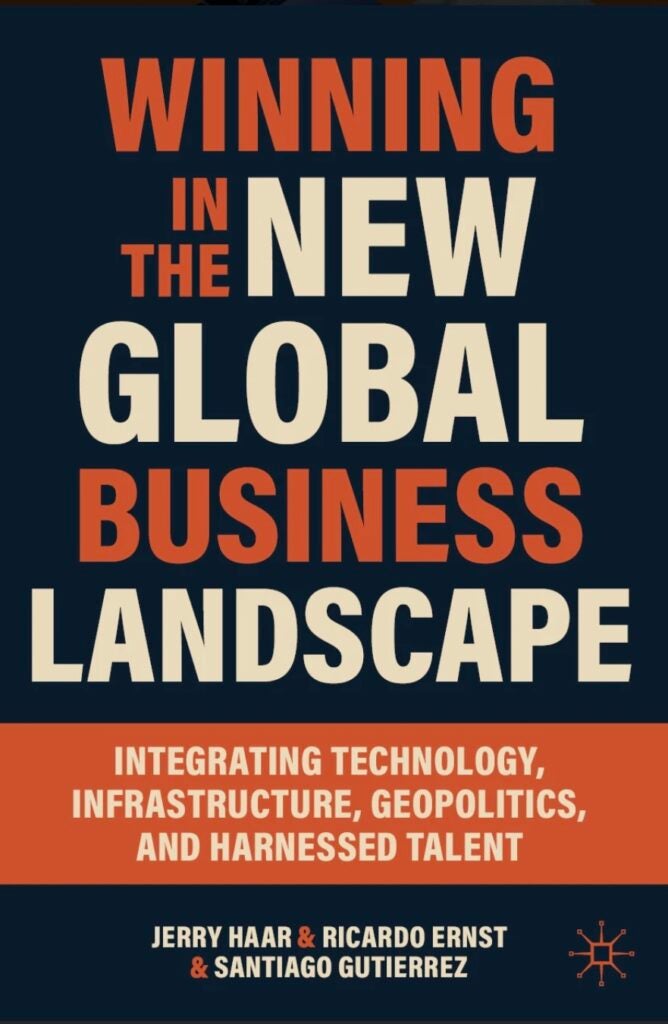
Book Cover, Winning in the New Global Business Landscape by Jerry Haar, Ricardo Ernst, and Santiago Gutierrez
Which emerging markets should business leaders be watching, and why?
Pay particular attention to India, Mexico, Vietnam, Indonesia, and select markets in Latin America. They benefit from different combinations of demographics, manufacturing capability, technology, resources, and changing trade patterns.
Mexico is especially interesting because nearshoring and North American integration are creating opportunities well beyond traditional low-cost manufacturing. The larger point, however, is not to search for the “next China.” The emerging global landscape will be more distributed, regional, and specialized with different countries playing different roles in global value chains.
How does the TIGHT framework apply to the opportunities and challenges facing Latin America today?
Latin America is an excellent example of why the four TIGHT dimensions must be considered together. The region has tremendous opportunities from nearshoring, digitalization, renewable energy, critical minerals, and its proximity to the United States. But capturing those opportunities requires better infrastructure, technological capabilities, predictable institutions, and investment in talent. Mexico illustrates the scale of the nearshoring opportunity, while countries such as Costa Rica show that Latin America can compete in sophisticated, high-value activities. The opportunity is not simply for Latin America to become a cheaper place to produce. It is to become a more strategic and indispensable part of the new global business landscape.
Related Stories

Business and Global Affairs, Student Experience
Executive MBA Expands International Locations for Signature Global Business Experience Consulting Projects

Research and Insights
Buying and Selling: Moving Away From Capitalism for Capitalism’s Sake