The Promise and Peril of AI in Healthcare: A Georgetown Panel Explores What’s Next
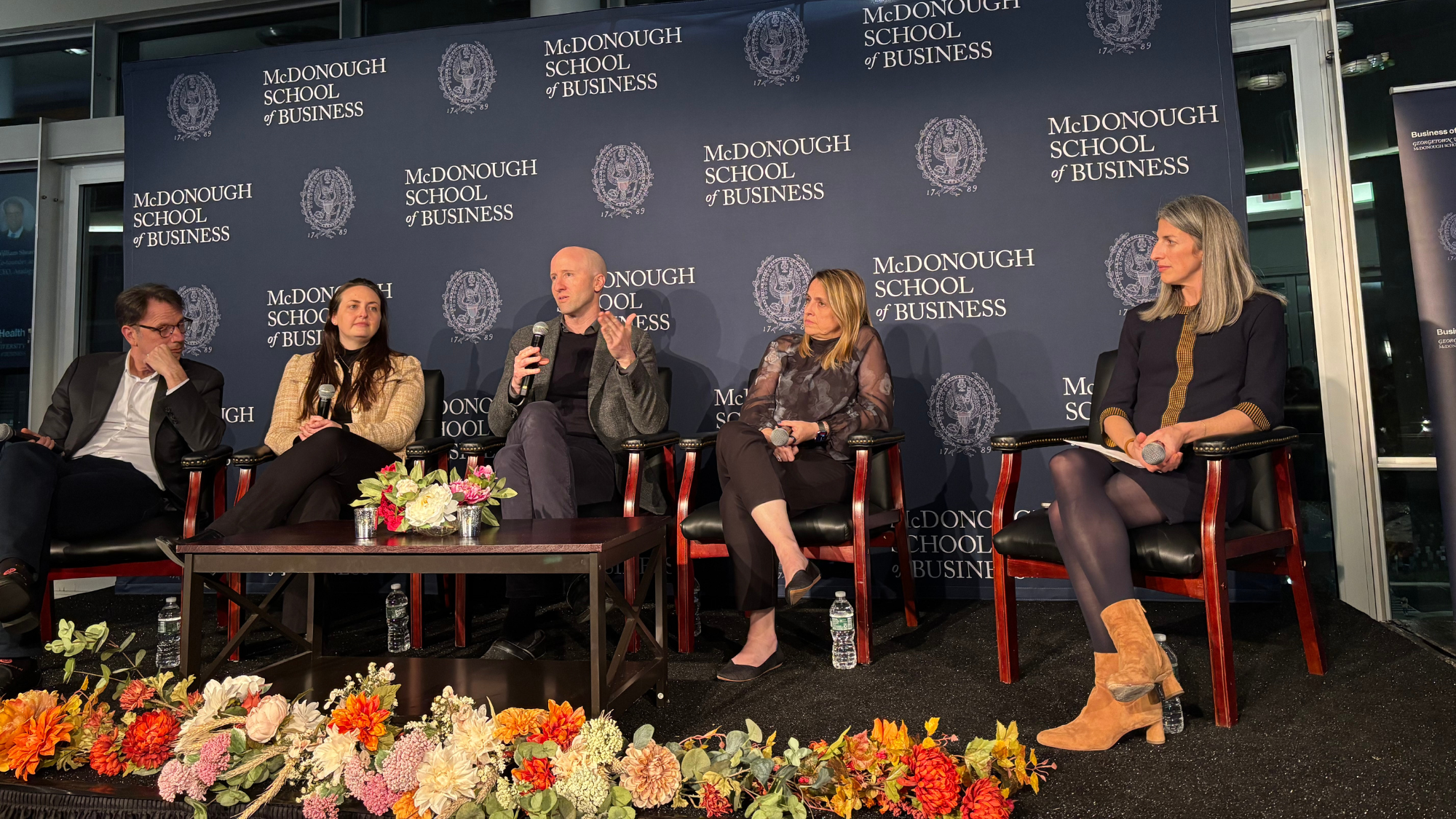
On a November evening, the Fisher Colloquium at Georgetown’s McDonough School of Business was packed with students, faculty, and industry professionals for a conversation at the heart of what the Business of Health Initiative is about: where innovation, ethics, and impact meet in healthcare.
The panel, “AI’s Disruptive Role in Healthcare,” brought together leaders from across healthcare to talk about artificial intelligence’s (AI) growing role in the field. Moderated by Rivka Friedman, head of healthcare innovation at Morgan Health, the discussion included Katherine Bobroske (Morgan Health), Ross Filice (MedStar Georgetown University Hospital), Diana Pankevich (Pfizer), and William Shrank (Aradigm) for an honest, wide-ranging conversation about both the promise and complexity of AI in medicine.
Teasing Out Complexities of AI
Pankevich started with a practical look at how Pfizer is thinking about AI adoption. She described a three-tier approach: quick wins like productivity tools, medium-term opportunities in manufacturing optimization, and longer-term “moonshots” like drug discovery for cancer therapeutics. But she was clear that success takes more than ambition. It requires clean, structured data, solid regulatory understanding, and real collaboration across disciplines.

William Shrank
The conversation shifted to design ethics when Shrank, former chief medical officer at Humana and now CEO of Aradigm, asked a fundamental question: “Who is the AI being built for?” If tools are designed to make things more efficient for intermediaries rather than improve outcomes for patients, he said, we risk repeating the very problems AI is supposed to solve.

Ross Filice
Filice, a radiologist and informatics leader at MedStar Georgetown, brought perspective from the front lines of clinical care. In radiology, he pointed out, algorithms can work so well that they create a new kind of risk: over-reliance. His team’s response? Reverse quality assurance conferences, where AI-assisted cases are reviewed to detect blind spots. Importantly, these aren’t framed as audits but as shared learning within a “just culture.”

Katherine Bobroske (center)
Bobroske raised the issue of bias baked into the data itself. Drawing on her work at Morgan Health, she explained how claims data often misses vulnerable populations and can reinforce existing disparities. She described emerging tools like synthetic data generation and fairness audits for AI models that offer some solutions. But, she added, technology alone won’t fix this. “It’s about governance, intentionality, and ongoing vigilance.”
Themes That Emerged
As the discussion wrapped up, a few key themes emerged:
- the need for patient orientation;
- the importance of data quality; and
- the responsibility to move forward thoughtfully.
“There are no easy answers, but this conversation demonstrates the serious, values-driven approach that is essential as healthcare continues to change,” noted Sandeep Dahiya, Crnkovich Family Business of Health Chair and director of the Business of Health Initiative. “We aim to create space in the initiative where innovation is matched by reflection, and where the future is shaped by people committed to both progress and equity.”
Related Content


- Tagged
- AI
- Business of Health