
Georgetown McDonough Launches Jesuit Values for Business Initiative to Strengthen its Values-Based Approach to Business
Georgetown University’s McDonough School of Business is deepening its commitment to forming business principled leaders through its newly launched Jesuit Values for Business Initiative. A first-of-its-kind effort among business schools, the initiative will intentionally integrate McDonough’s values-based approach across the full student experience, including curriculum, student formation, community life, leadership development, and school-led impact programs.
The Jesuit Values for Business Initiative builds on the school’s longstanding commitment to educate the whole person and prepare women and men for others. Through academic, co-curricular, and community-based experiences, the initiative will help students develop the self-awareness, discernment, and sense of purpose to consider not only what they can achieve through their careers but how they can contribute to human flourishing and the common good.
“We believe business education should prepare students to lead with purpose, integrity, and a deep sense of responsibility for the impact of their decisions,” said Paul Almeida, dean and William R. Berkley Chair at Georgetown McDonough. “The Jesuit Values for Business Initiative builds on work that has long been part of the Georgetown tradition while creating a more intentional framework for how we support and advance our values across the school. By bringing greater focus and resources to our Jesuit heritage, we deepen the formation of our students and equip them to do well, do good, globally in a world that needs principled leadership more than ever before.”
Forming Leaders for a Lifetime of Purpose
At the center of the initiative is student formation: helping students reflect on who they are, what they value, and how they want to use their education and talents in the world.
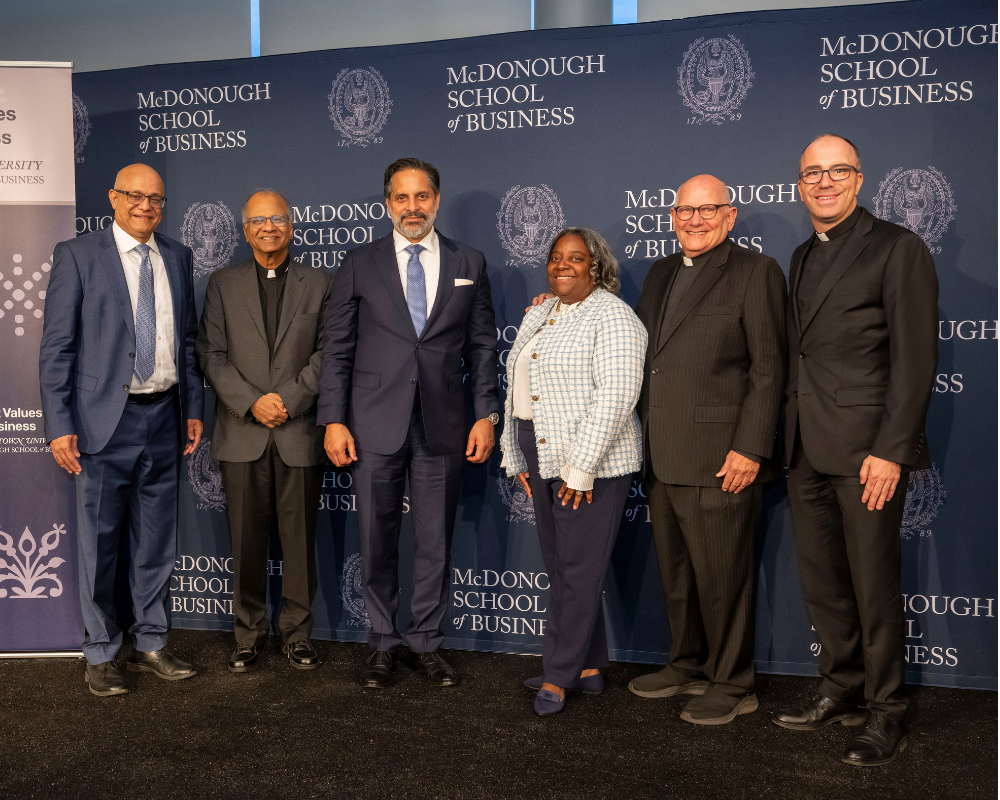
University and Jesuit leadership during the Jesuit Values for Business Initiative launch. Left to right: Dean Almeida; Fr. Joseph Christie, secretary for higher education, Society of Jesus; President Peñalver; Patricia Grant, senior associate dean of undergraduate programs; Fr. Ronald Anton; Fr. Quentin DuPont.
Through a variety of retreats, reflection programs, service opportunities, and immersive experiences, students will have opportunities to explore questions of purpose, vocation, and leadership throughout their business education. The initiative will also support the integration of Jesuit values into curriculum and pedagogy through faculty consultations, workshops, interdisciplinary research, and opportunities for faculty and staff engagement.
“The Jesuit tradition gives us a powerful framework for asking students to look beyond the immediate demands of a career and reflect on the kind of person and leader they want to become,” said Javier Bustamante, director of Jesuit Business Initiatives at Georgetown McDonough. “Formation is a lifelong process. Our goal is to create experiences that help students develop the habits of reflection and discernment so they can make thoughtful decisions, recognize their responsibilities to others, and bring their values with them both personally and professionally.”
The initiative is grounded in a Head-Heart-Hands framework. Head brings Jesuit values into curriculum, pedagogy, and scholarship. Heart creates opportunities for students, faculty, and staff to encounter and reflect on those values in their everyday experiences. Hands translates those values into action through service, social impact, and mission-driven programs.
“These rich traditions that are centuries old have been pivotal to the way I approach my teaching and scholarship and the way I engage with students,” said Jeanine Turner, Annette N. Shelby Endowed Chair in Business and Leadership Communication at Georgetown McDonough, during a fireside chat at the initiative’s launch event. “Faculty play a critical role for the student experience, and it is important for faculty to have the opportunity to learn about the Jesuit tradition so they can see how it can best fit in the way they teach and research.”
Jesuit Values in Business
Georgetown’s Jesuit values offer a distinctive perspective on the purpose of business and the responsibilities of leaders in the world today. Rooted in more than 500 years of Jesuit heritage, the school’s values-based approach emphasizes the education of the whole person, intellectual excellence, human dignity, contemplation, and a deep commitment to serving others.

Bustamante addresses the audience during the service at Georgetown’s Dahlgren Chapel.
“In a world facing increasingly complex global, economic, and technological challenges, we believe business is not separate from questions of values and social responsibility,” said Almeida. “We want students to learn the skills and frameworks necessary to lead in business, but more importantly, we want them to have the discernment to understand how they should lead.”
The Jesuit Values for Business Initiative complements McDonough’s broader strategic priorities, including its commitment to the Fields of the Future, working alongside the school’s existing centers, initiatives, and programs to bring a values-based perspective to the many ways the school engages with business and society.
Serving the Common Good
The Jesuit Values for Business Initiative will work with McDonough’s signature programs to ensure students can put the principles of service into practice while engaging directly with individuals and small businesses within the local community.
Now in its ninth year, the Pivot Program equips individuals who have previously been incarcerated with rigorous classroom training, hands-on work experience, and building an entrepreneurial mindset. Over the course of several months, Pivot Fellows discover potential vocational paths and develop the skills needed to succeed in both the workplace and as leaders in their communities.
“I came out of Pivot understanding that Jesuit values aren’t just posters on a wall,” said Talib Shakir, a Pivot Fellow and executive director of the Mayor’s Office on Returning Citizen Affairs, during a fireside chat at the launch event. “They’re habits. They’re ways of treating people. They’re ways of showing up. And they’re a pretty good way to run a business and a life.”
Through the Small Business Corps, students can apply their business knowledge and skills to provide consulting support to small businesses in underserved communities across the Washington, D.C., Maryland, and Virginia region.

Executive Director of the Georgetown Pivot Program Alyssa Lovegrove speaks with Pivot Fellow Talib Shakir and Small Business Corps Fellow Shivika Sachdev (MBA’27) during the launch celebration.
“People for Others became much more tangible for me through the Small Business Corps,” said Shivika Sachdev (MBA’27), a current Small Business Corps Fellow, during the launch event. “I want to carry forward the habit of asking myself, ‘Who is ultimately affected by this decision?’ and SBC helped me look beyond just the function, the process, or the spreadsheet and think more about the people on the other end of those decisions.”
Since its launch in 2024, SBC has served 41 local businesses across over 50 impact projects with 83 student consultants, resulting in over 24,800 hours of service.
McDonough is also home to the First Year Seminar Social Impact Consulting Projects, the Ethics Project, and BUILD, among many other programs and initiatives that ask students how to positively impact their communities. The initiative will help strengthen these programs and explore new opportunities for the school to engage with the local community and address societal challenges through business.
“Our students should have opportunities to experience what it means to use their business education in service of others,” said Bustamante. “Programs like Small Business Corps and Pivot allow students to understand that leadership is ultimately about how we use our talents and resources to support those around us, particularly in underserved communities.”
The Jesuit Values for Business Initiative is led by Bustamante, with Michael Garanzini, S.J., senior advisor on Ignatian pedagogy, and Quentin Dupont, S.J., senior director for Ignatian formation.
For more information, visit jesuitbusiness.msb.georgetown.edu.
Related Stories

Alumni, Jesuit Values, Leadership
Values in Action: How Georgetown’s Jesuit Values Ground the Next Generation of Business Leaders in Purpose