
Meet Javier Bustamante: The Leader Who Forms People for Others
A promise made at an airport more than three decades ago set Javier Bustamante on a lifelong pursuit of education, service, and purpose. His path has taken him from Peru to Washington, D.C., through careers in ministry, nonprofit leadership, and higher education, where he has championed programs that help people discover a sense of belonging and reach their full potential. Today, Bustamante brings that same commitment as the director of the Jesuit Values for Business Initiative, advancing Georgetown McDonough’s values-based mission and preparing leaders who see business as a force for the common good.

Javier Bustamante, director of the Jesuit Values for Business Initiative at Georgetown McDonough
How did you choose your career path?
When I left Peru at the age of 12, I made a promise to my father. That day at the airport, he explained what the move to the United States represented for our family, and I promised him that, no matter what, I would never allow anything to stand in the way of my education. That promise was not about a specific career or profession, but about ensuring that I would embrace every opportunity to educate myself. In that moment, education itself became the goal.
My path was anything but linear. I considered becoming a doctor, lawyer, economist, teacher, or theologian, and I knew that whatever I ultimately chose to do, college would be the bridge to get me there. After three years at a community college and changing my major at least five times, I transferred to Loyola Marymount University to study history and pastoral theology and later earned a master’s degree in Latin American studies at Georgetown. After graduate school, I worked in ministry, nonprofit leadership, and multicultural outreach, often discovering new opportunities through unexpected turns.

I got married in 2012, and a year later, my daughter was born. We decided to return to the Washington, D.C., area to be closer to family, and I joined the National Federation for Catholic Youth Ministry, where I led fundraising efforts. A year later, I transitioned into the role of executive director of cultural diversity and outreach for the Archdiocese of Washington where I had the opportunity to work with immigrant communities, equip leaders to serve diverse and multicultural parishes, and participate in a national process focused on strengthening the Catholic Church’s response to the growing Latino presence.
In 2018, I joined The Catholic University of America, where I launched Take Flight, a first-generation student success program that grew from serving 25 students to more than 200. That experience helped me discover a passion for higher education and led me to pursue a doctoral degree in higher education administration.
Now at Georgetown McDonough, I am excited to help advance the school’s Jesuit mission and values-based approach to education. Through every chapter of my career, one purpose has remained constant: helping people realize their potential and pursue lives rooted in enduring values.
What is your personal philosophy?
About a year ago, I read a book about ancient Aztec philosophy that has resonated with me deeply. In presenting their philosophy on the purpose of life, the author explained that the ancient Aztecs would likely reject certain Western notions that define the purpose of life as the pursuit of happiness. Instead, the Aztecs believed that a good life is a rooted life. Like the majestic ahuehuete tree (Montezuma cypress), the deep roots we cultivate make the difference between being swept away by the storms of life and withstanding the transformative forces that shape us. Similarly, my personal philosophy is that developing deep roots in our values is essential to living a virtuous life – a life that enables us to become people for others.

Bustamante with his wife and two children in New York City, New York
Personally, I am rooted in family, faith, learning, service, and my identity as an immigrant. I believe that nurturing our bonds with family and community is essential, especially in a modern world where many of us live far from those we love. Similarly, faith helps us discover paths forward, even in the difficult moments when life feels most challenging. Learning is a lifelong process; we never cease discovering new things and expanding our minds in ways that reveal deeper insights into the human experience. Service is a grounding practice because it connects us to the broader community and expands our sense of purpose. Finally, my identity as an immigrant has allowed me to inhabit the liminal spaces of life – always searching for home while simultaneously experiencing a sense of having arrived. These are the truths that shape and inform my personal philosophy.
What drew you to Georgetown?
I’ve long desired to come and work at Georgetown. As someone who attended a Jesuit university in California, I was very interested in continuing my education at another Jesuit institution. Before making my decision, I had the opportunity to visit Georgetown with a friend. I remember standing outside the Intercultural Center, looking around, and feeling that I had found my place. That connection never left me.
What draws me most to Georgetown is its commitment to forming people for others. I first encountered that Jesuit ideal as an undergraduate and spent much of my career pursuing mission-centered work that supports human flourishing through education, service, and community. Now, joining a Jesuit institution as a staff member further strengthens my commitment to remaining rooted in this conviction: that we are all called to become people for others.
I feel truly blessed to be at Georgetown, especially in a role where I will help ensure that the McDonough School of Business remains rooted in its Jesuit identity. As an immigrant, I understand the importance not only of knowing where you come from, but also of making a concerted effort to remain connected to your roots and to live out the values they represent. While a person’s ideas and outlook may evolve through experience, learning, and new perspectives, there are essential truths that ground us and allow us both to dance in the rain and rejoice in sunny days.
How are you influenced by Georgetown’s Jesuit values?
One of the Jesuit values that resonates most deeply with me is people for others, which has influenced my academic, professional, and personal decisions. The complementary, or perhaps guiding principle, is the value of faith that does justice.
In 1972, the late Pedro Arrupe, S.J., then superior general of the Society of Jesus, wrote that “we [Catholics] must back up the Church’s teaching on justice with our witness to justice. And it must be a witness that is truly convincing.” In the same letter, Arrupe reflected that the world needs witnesses more than teachers, and that witnessing to justice is what our modern world needs.
In 2013, another Jesuit, Jorge Mario Bergoglio, S.J. (Pope Francis), speaking to a crowd in Rio de Janeiro, Brazil, called us to “never tire of working for a more just world, marked by greater solidarity!… Everybody, according to his or her particular opportunities and responsibilities, should be able to make a personal contribution to putting an end to so many social injustices.”
For me, calling myself a Christian means striving to live a life rooted in justice. The pursuit of justice is central to my understanding of loving God, whom I cannot see, through the love I extend to others, whom I can see.
What can we find you doing outside of Georgetown?

Bustamante enjoying quality time in the winter season with his kids
I enjoy spending quality time with my wife and two children. Throughout the year, we enjoy a variety of activities that correspond with the changing seasons. In the summer, we like to soak in the sun and spend time swimming. In the fall, we enjoy apple picking, hiking, and taking in the beautiful colors of the season. During the winter, we prepare for the holidays by watching Christmas movies, decorating our home, and baking all kinds of tasty treats. Finally, in the spring, we enjoy spending time outdoors and celebrating the Easter season. Throughout the year, we also enjoy movie nights, game nights, and exploring different places around the region.
Some of my personal hobbies include reading, watching NBA games, and listening to podcasts while walking my dog. These days, you can also find me conducting research and interviews as I work toward completing my doctoral degree. Finally, I value moments of quiet and solitude that allow me to connect with my higher power and the source of strength that sustains me.
How would you describe the sense of community at Georgetown McDonough?
Over the past six months, I have had the joy of getting to know the McDonough community. Conversations with my colleagues have given me a glimpse into what makes this community so special and why McDonough feels like such a unique place. I have seen the genuine care that faculty members bring to their craft as they educate and form the minds of their students; I have seen the deep desire to serve that motivates staff members as they support students in achieving their goals; and I have seen the ways in which leaders continually reflect on how the school is living out its Jesuit identity.
During this time, I have also had several opportunities to meet students. In each of these interactions, I have seen that McDonough is not only an educational institution but a place that fosters a deep sense of belonging. Students frequently speak about experiencing cura personalis, or care for the whole person, and recognize that the formation they receive is not only preparing them for successful careers but also providing them with the tools needed to flourish as individuals. They express excitement about becoming ambassadors of this great school and supporting future Hoyas in the same way they themselves were supported during their time as students. This is a testament to the extraordinary work of faculty and staff who tirelessly dedicate themselves to the important mission of forming people for others.
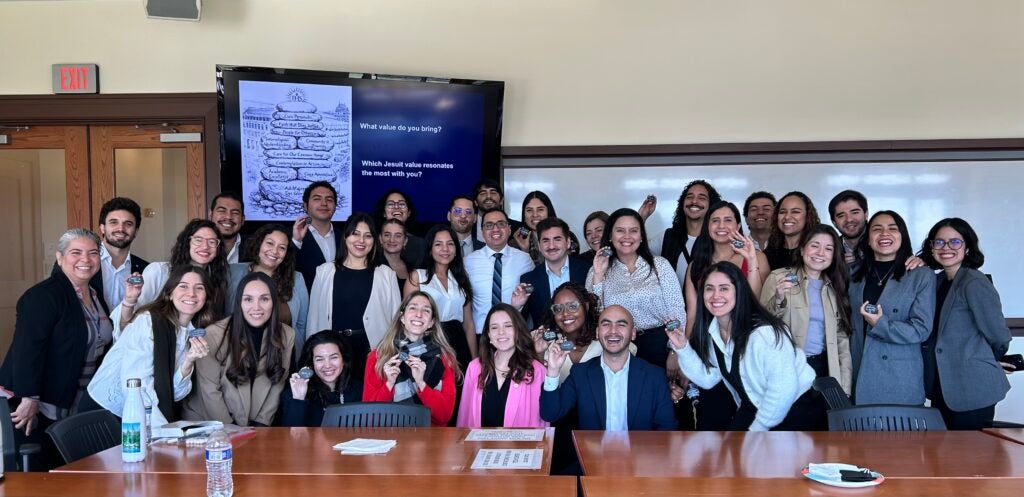
Bustamante facilitating a session on Jesuit values with students participating in McDonough’s Global Competitiveness Leadership program
Why are Jesuit values so important to business today?
The challenges facing our world are increasingly complex and global. While business plays a critical role in identifying problems and creating solutions, it also needs to have a heart and a clear set of values. The Jesuit values that we espouse provide a deeper framework for developing business as a force for good.
The Jesuit values are not a modern-day formulation – they have been cultivated over the past five centuries and have evolved in response to the signs of the times in every era. These values provide a framework for understanding that business is not merely about generating economic value but about serving humanity and advancing the common good. They remind us that every decision made within a business has an impact on people, communities, and the world we share.
In an increasingly complex and interconnected world, business leaders need more than technical expertise. They need the capacity to discern, to listen, to engage diverse perspectives, and to make decisions rooted in a deeper sense of purpose. Jesuit values provide this foundation by forming leaders who understand that business is not separate from society, but an essential part of shaping the world we inhabit.
Related Stories

- Tagged
- Jesuit