How AB InBev Turned its 10-Year, $1B Corporate Social Responsibility Initiative into a Global Public Health Strategy
How can a beer company help make a difference in society when many policymakers and health experts do not want it involved?
The world’s leading beer company Anheuser-Busch InBev SA/NV (AB InBev) used its market position to address this question in a 10-year $1 billion USD strategy to reduce harmful alcohol use. In a new study produced by Business for Impact at Georgetown University’s McDonough School of Business, leading researchers analyzed this corporate strategy as a use case for how companies can use corporate social responsibility to drive positive change in their respective industries.
“This is a landmark achievement,” noted Leslie Crutchfield, executive director of Business for Impact. “AB InBev carried through on a bold 10-year commitment. While not every goal was fully realized, significant progress was made on each front, including several unexpected breakthroughs that are having global impact for consumers who seek lower- and no-alcohol beverage choices.”
Developing a CSR Strategy for AB InBev
When the World Health Organization (WHO) committed to tackling harmful alcohol use in 2010, it recognized that public health officials could not solve the issue alone. Reducing alcohol-related harm globally required collective action across sectors.
In 2015, AB InBev set out to be part of the solution, despite the public health community’s skepticism of the industry’s involvement. The company launched the Global Smart Drinking Goals (GSDG), a bold 10-year strategy to invest in initiatives that support the WHO’s goal to reduce harmful use of alcohol globally by 10% by 2025.
The case study, The Global Smart Drinking Goals, evaluates AB InBev’s decade-long effort around GSDG, provides insights into the company’s corporate social responsibility initiatives, and offers lessons learned. Ultimately, the case study intends to show how the company went beyond traditional corporate responsibility and regulatory compliance to create shared social and economic value delivered through its core business model and strategic philanthropic investments.
AB InBev’s GSDG strategy included four key initiatives:
- Piloting new public health interventions in six cities
- Shifting societal norms and consumer behavior through social norms marketing
- Launching new lower-alcohol beer and no-alcohol beer products
- Using product packaging to educate consumers about preventing harmful drinking behaviors
In 2025, AB InBev and AB InBev Foundation provided financial support to Georgetown’s Business for Impact to produce the case study. The research team assessed AB InBev’s progress toward achieving its goals, analyzed what worked and what did not, and provided insights and recommendations on how the business can improve its approach in the future.
Author Ladan Manteghi, senior advisor and adjunct professor at Georgetown’s Business for Impact, led the case team, working together with Myriam Sidibé, chief mission officer and founder of Brands on a Mission, to write the case and develop recommendations for how industry, policymakers, non-commercial organizations, academics, and future leaders can collaborate as allies to tackle societal challenges at scale.
Over the course of a decade, insights emerged across all four of the GSDG strategies, which led AB InBev to reconceive its products and markets, leverage its influence across the global value chain, and invest in local business environments worldwide.
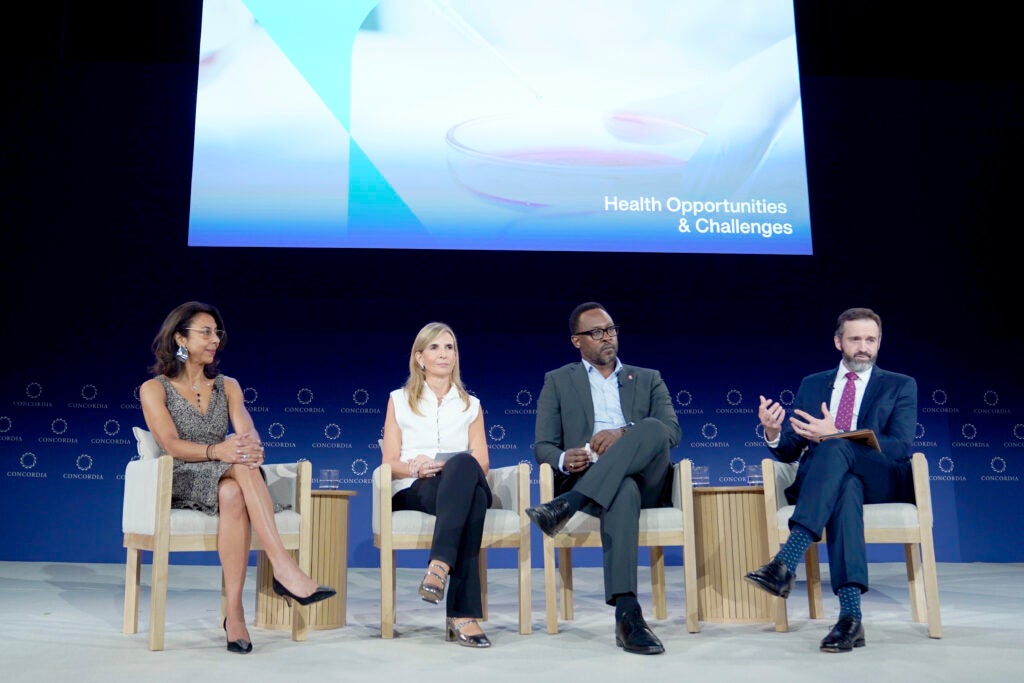
Concordia Annual Summit in New York City 2025 with panelists Ladan Manteghi (left), who previewed the case study on a panel with Cata Garcia (middle, left), Tom Achoki (middle right), and Sam Stephens (right) of ABI InBev and AB InBev Foundation | Photo by Riccardo Savi/Getty Images
No-alcohol beers (NABs) and lower-alcohol beverages were identified as a growing market opportunity that aligns with changing consumer interests and harnesses AB InBev’s core business model to support the smart drinking goals. Another key insight from the case centers on how AB InBev maximized the impact of its CSR goals by harnessing all the tools available to advance the cause – including leveraging the power of its mega-brands; applying world-class marketing expertise to nudge pro-social norms and behavior change; investing in commercial product innovation and renovations; traditional philanthropy, and more.
Looking Toward 2030
WHO’s Global Alcohol Action Plan 2022-2030 continues to push for multisectoral action and harm reduction. AB InBev’s GSDG set a north star for the company to actively lead the industry in reducing harmful drinking and its consequences. It has embedded promoting moderation into its core business strategy.
“We have a big dream as a company to create a future with more cheers, meaning offering more people more reasons to celebrate responsibly,” said Michel Doukeris, chief executive officer at AB InBev. “Our partners, governments, and other stakeholders helped us better understand how to reduce harmful drinking and how to make moderation more tangible for consumers.”
Going forward, the insights gained from a decade of Smart Drinking can serve as a roadmap for multisector collaboration to drive both social and business benefits.