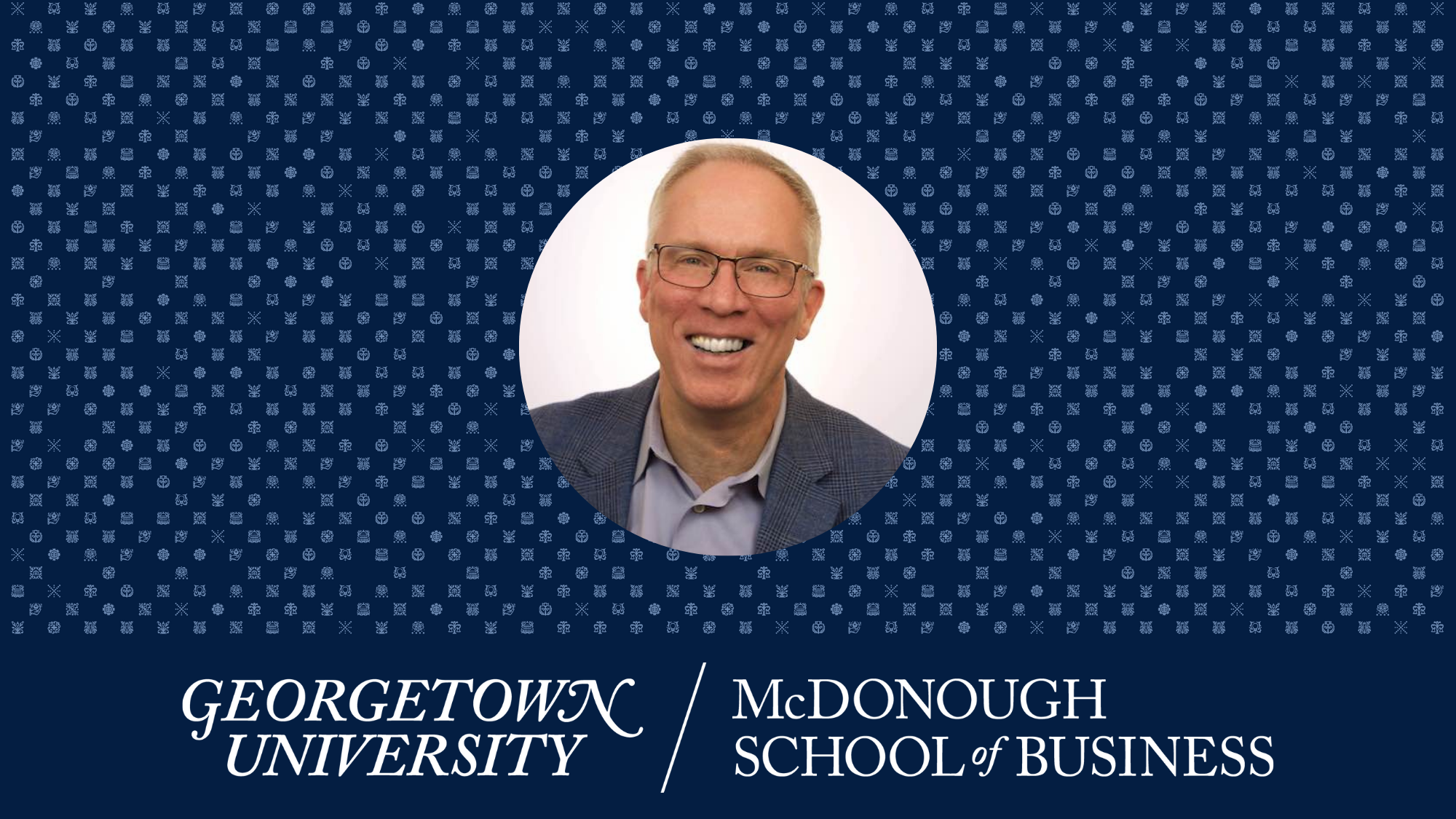
Meet Kenneth Sawka: The Professor Driven by a Meaningful Mission
Kenneth Sawka, associate teaching professor of strategy, economics, ethics, and public policy, brings more than 30 years of professional experience to the classroom. His background spans business strategy, intelligence and national security, and organizational leadership development for public- and private-sector organizations around the world. This fall, Sawka began a new role at Georgetown McDonough as the academic director of the Master’s in Management (MiM) program, continuing to build on its growth.
How did you choose your career path?
I like to joke that my career path chose me. As a political science major in my undergraduate program, I wanted to enter government service and was fortunate to be selected for a position in the U.S. intelligence community. In that position, I analyzed the impact of technology innovation on the foreign defense and aerospace industries, and my work was used to inform U.S. trade policy. I really liked that kind of industry analysis and wanted to bring my experience to the private sector. That launched the beginning of what would become a 25+ year career in strategy consulting, with a focus on competitive strategy and competitive intelligence, supported by analytic techniques and frameworks I had learned in government service.
About 10 years ago, I was asked to take a role as an adjunct professor in an intelligence studies program at Northeastern University, which ignited a love of university teaching. Fast forward, here I am at Georgetown McDonough, with an opportunity to bring my strategy consulting and teaching experience to our wonderful students. My career journey was somewhat serendipitous, allowing me to discover different passions and interests along the way.
What is your personal philosophy?
I like to think that I am, or at least try to be, mission-oriented. My decision to enter government service demonstrates that my primary objective never was to make a lot of money. Instead, I wanted to be sure any career path I followed was comprised of roles in organizations that pursued a clear and specific mission. For my work in the intelligence community, the mission was national security and the advancement of U.S. foreign policy. In consulting, it was giving firms the tools, analysis, insights, and confidence to create value for themselves and their stakeholders. Now at Georgetown, I’m proud to support our mission to educate women and men to be reflective lifelong learners, responsible and active participants in civic life, and to live generously in service to others.
What are students surprised to learn about you?
What surprises students the most is the wide variety of industries I have had the chance to work in, and on, during my consulting career. They often hear me say I had a client in the pharmaceutical, consumer products, technology, financial services, or many other industries, and I like to spin stories about my experience working in those sectors that are relevant to what I’m teaching in the classroom. I’ve even worked in the “death services” industry, having had a manufacturer and distributor of caskets as a client!
What can we find you doing outside of Georgetown?
I’m an avid cyclist and passionate baseball fan. Most weekends, I’m out for a 40- to 50-mile bike ride, and depending on the time of the year I may also be training for a century ride (100 miles). I’ve completed five so far and am still going! I’ve also visited all 30 major league baseball stadiums – that was a 10-year project with my family that gave us an opportunity to travel the country and show my two children (now adults who are 26 and 29 years old) the expanse and diversity of our country.
How are you influenced by Georgetown’s Jesuit values?
Georgetown’s Jesuit values really guide how I teach. Of the collection of our Jesuit values, cura personalis is the one that speaks to me the most. I’m here not just to educate our students, but to help them apply mind, body, and spirit to all that they do. I strive to care for the entire person – not just their intellect, but their sense of well being, self-confidence, and happiness.
What has been the biggest change to the business world since you started teaching?
Well, the easy answer here is AI. Thinking more broadly, it is the abundance of information our students have access to, and the variety of ways they can access it. I’m old enough to remember having to request a copy of a firm’s annual report BY MAIL! Today, a student can fire up ChatGPT or Claude and not only access the annual report in seconds, but have it summarized and delivered in any format they want. There are, of course, benefits and risks to this ease and variety of information access, not the least of which is questioning the accuracy and truthfulness of any individual source of information (including AI).
How would you describe the sense of community at Georgetown McDonough?
Exceptional. When I first joined the McDonough faculty, I was welcomed warmly and supported beyond expectation. My colleagues were quick to provide assistance (“where, exactly, is Fisher Colloquium?”), support my teaching (“here are the PowerPoint slides I used in your course last year, and here’s my exam question bank”), and make me feel very welcome. The fact that we all share the same mission – to make sure we are giving our students the best business education possible – is energizing.
What is the one thing you hope students take away from your program?
To be critical thinkers. In my courses in strategic management and international business, there are no right or wrong answers. Most business problems are gnarly and require objective analysis supported by relevant concepts and frameworks. I want my students to be able to show me how they arrived at an answer, judgment, or recommendation; why they believe that’s the best way to examine and solve the problem; and be confident in their defense of their judgments when challenged or questioned.
What is the one thing you recommend students do before graduating from your program?
Find a problem to solve. That can be through conducting original research, making the most out of an internship that gives them a chance to contribute to a firm’s strategy development and implementation, or contributing their knowledge and critical thinking skills in a community service opportunity.
Related Stories

Curriculum, Student Experience
Rising to the Challenge: How Georgetown’s MiM Program Prepared Me to Lead with Confidence