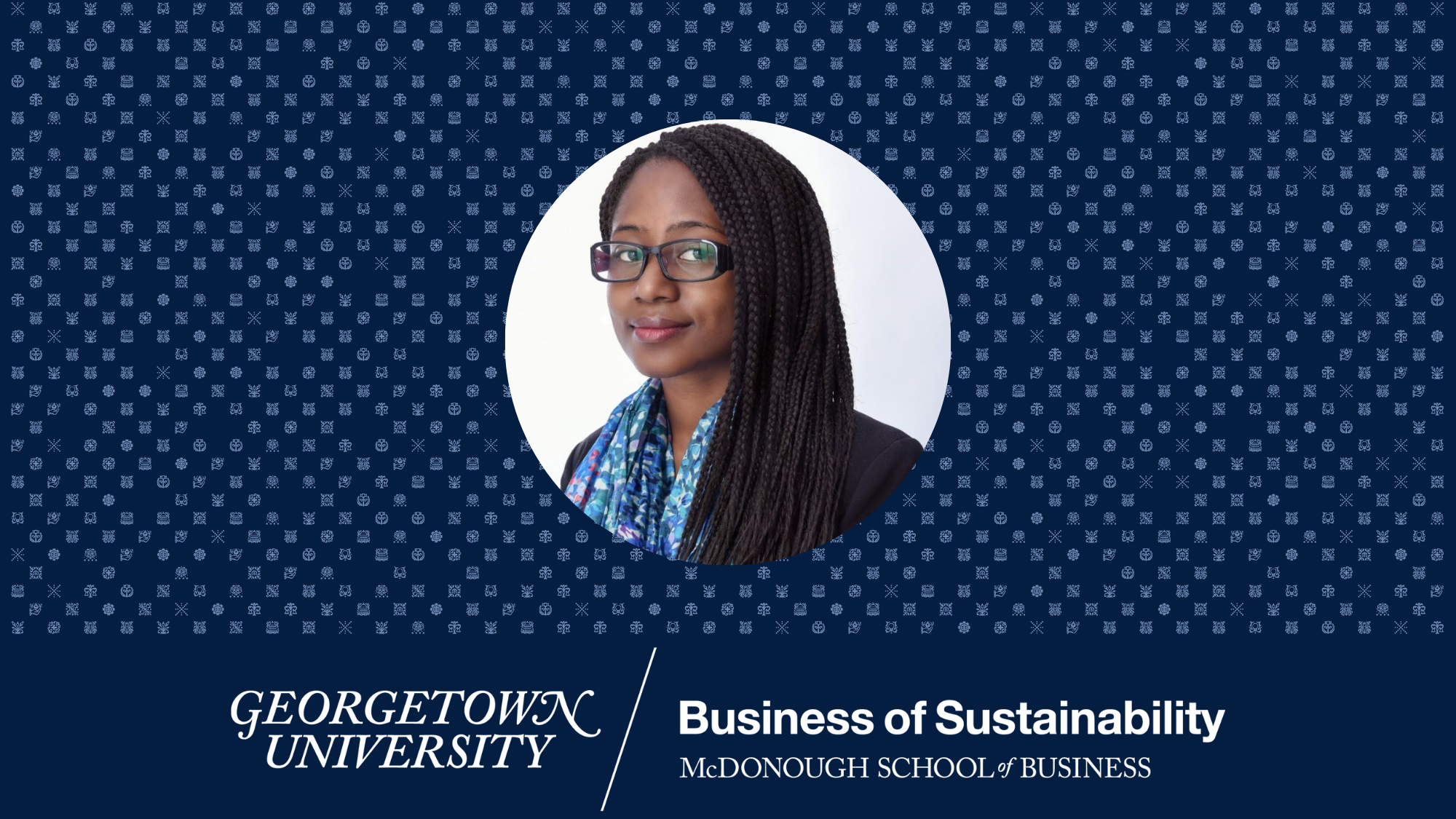
Bridging Sectors, Building Systems: Mureji Fatunde-Iloeje on Operational Innovation in Emerging Markets
At Georgetown McDonough’s Business of Sustainability Initiative, postdoctoral scholar Olumurejiwa “Mureji” Fatunde-Iloeje explores how public and private institutions can rethink delivery to meet social, environmental, and economic goals.
She was drawn to the Initiative’s emphasis on real-world impact, viewing it as an ideal fit for her systems-oriented research on institutional service delivery in emerging markets.

Mureji Fatunde-Iloeje
From Global Health to Institutional Systems
With experience spanning global health, public-sector delivery, and sustainable operations, Fatunde-Iloeje brings a unique interdisciplinary lens to her research. She investigates how firms and governments, particularly in emerging markets, can rethink how they deliver essential services, from electricity to vaccines.
Fatunde-Iloeje credits her upbringing in an immigrant family and her wide-ranging global experiences — from Africa and the Middle East, to Europe and South Asia — as key influences on her interest in how institutions function. In particular, her previous work on vaccine supply chains in Nigeria sparked a deep fascination with the systems that underpin the delivery of everyday products and services.
“I’m personally offended by poor service,” Fatunde-Iloeje says, half-joking. “If your whole mission is to get items from point A to B in a certain amount of time, or deliver essential services — and that’s not happening — I want to understand why.”
Research at the Intersection of Impact and Delivery
This curiosity led Fatunde-Iloeje to pursue a Ph.D. in operations management and decision sciences at the Massachusetts Institute of Technology. Today, her research explores the economic and social dimensions of sustainability across both public and private sectors, focusing on how data and innovative business models can help address delivery challenges and advance goals like job creation and sustainable development.
“My mission has always been to help companies and governments better meet societal and consumer needs,” Fatunde-Iloeje explains. This drew her to McDonough’s Business of Sustainability Initiative, which brings together faculty from across disciplines to tackle complex sustainability problems.
For Fatunde-Iloeje, these problems are especially urgent in emerging markets, where public agencies and firms face “compound challenges,” such as simultaneously expanding basic energy access while participating in the global clean energy transition. However, she sees this tension not only as a hurdle, but also as fertile ground for innovation.
“It’s not about choosing between sustainability and commercial viability,” she says. “The key question is how to align environmental and social goals with business models that work: that’s where the real innovation lies, and that is the gap I hope to fill.”
Projects with Real-World Urgency
In her postdoctoral role, Fatunde-Iloeje is focused on expanding her research portfolio, deepening her engagement with students, and contributing to the Sustainability Initiative’s policy outreach efforts. Among the projects she is most excited about is a study examining the role of voluntary carbon offsets in corporate decarbonisation strategies, amid growing debate about their effectiveness and integrity. She is also investigating how to incentivize local vaccine manufacturing in Africa: a challenge made more urgent by recent shifts in global development policy, including the closure of major aid institutions and a broader rethink of foreign assistance.
Alongside her research, Fatunde-Iloeje is eager to connect with the McDonough community and looks forward to supporting the initiative’s upcoming policy outreach events, including the Leadership and Innovation Summit on Sustainable Supply Chains in November.
For Fatunde-Iloeje, research, teaching, and outreach form a three-pronged approach, each in service of a larger goal: helping companies and public institutions make better decisions.
“There is so much work to be done. But whether that means writing papers, advising on strategy, or sharing insights publicly, I’m down to do what’s needed,” she says. “It’s about getting the message out there.”
She believes the power of research lies in its ability to guide action across sectors, especially in moments of transition. From shifting global aid structures to evolving energy systems, Fatunde-Iloeje sees critical opportunities for academic insight to support more responsive, resilient institutions.
Related Content
- Tagged
- Sustainability