Launch Pad: Addressing the World’s Toughest Problems
How Rhett Smith helps The Engine incubate solutions to the world’s toughest problems.
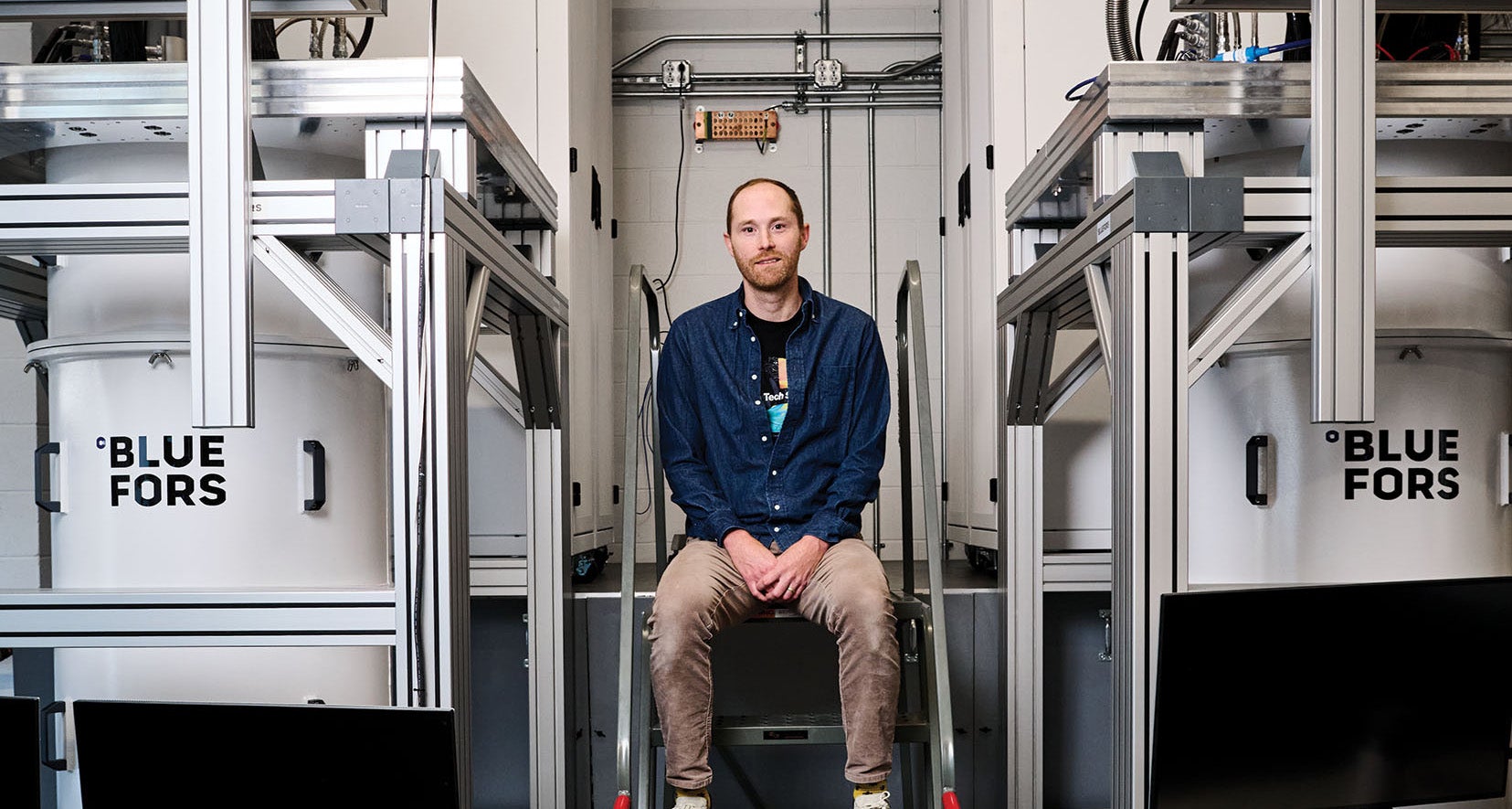
One of Rhett Smith’s (MBA’17) favorite things to do while giving tours of the office of The Engine, a nonprofit incubator and accelerator built by MIT where he works as vice president of operations, is to walk visitors through the first-floor lab space. On one side, a startup named Mantel, which is developing technology to pull CO2 out of the atmosphere, is blasting 25-foot-tall furnaces at 800 degrees Celsius; on the other side, Atlantic Quantum is operating computers at a necessarily frigid temp of absolute zero. “So it’s about a 10,000-degree Fahrenheit difference and just about 30 feet apart,” says Smith. “It’s wild.”
It’s a unique contrast that belies the organization’s distinctive approach. “We support technologies somewhere at the intersection of scientific breakthroughs and engineering breakthroughs that are trying to solve or tackle the world’s toughest challenges,” says Smith. The shorthand label for the kind of companies The Engine supports is “tough tech.” “We’re industry agnostic — we care more about the wider impact that these companies want to create.”
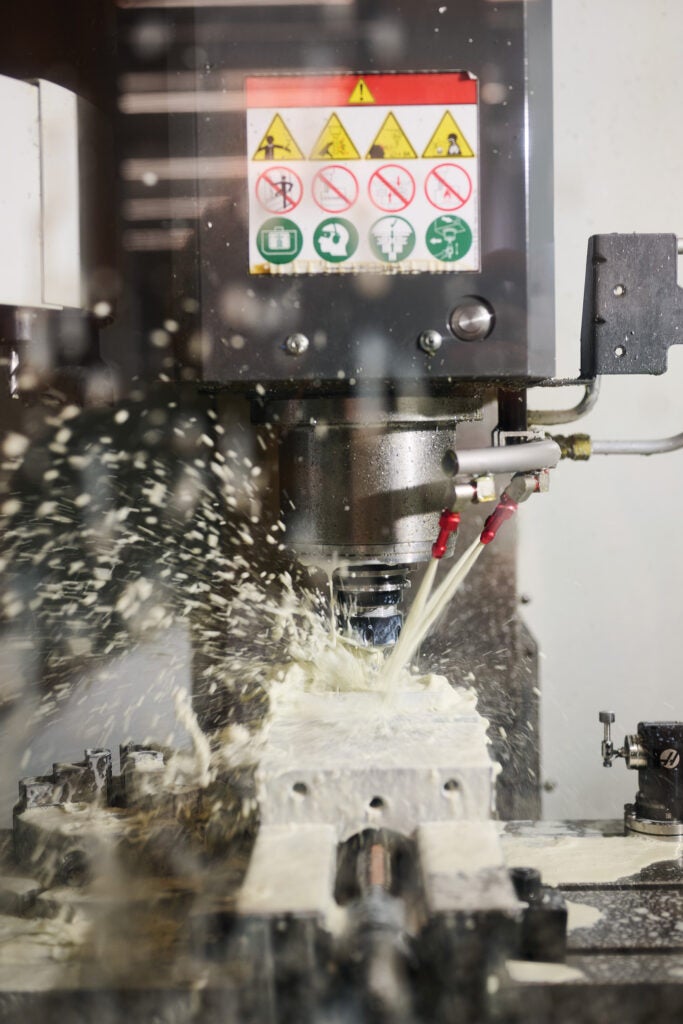
The Engine’s 150,000-square-foot Cambridge, Massachusetts, building’s combination of wet labs and engineering prototyping spaces — filled with 3D printers, laser cutters, welding machines, and mills — makes it one of the few places in the world where these tough tech startups can go from plan to product. “It’s the convergence of those two things under one roof that makes us very unique,” Smith says. Whatever The Engine can’t provide teams, they will try to find for them. “We’ve done a lot of work in this ecosystem, so we have a ton of relationships with other facilities in the area that have very technical, very expensive equipment — and we can get any team in there for pretty reasonable rates.”
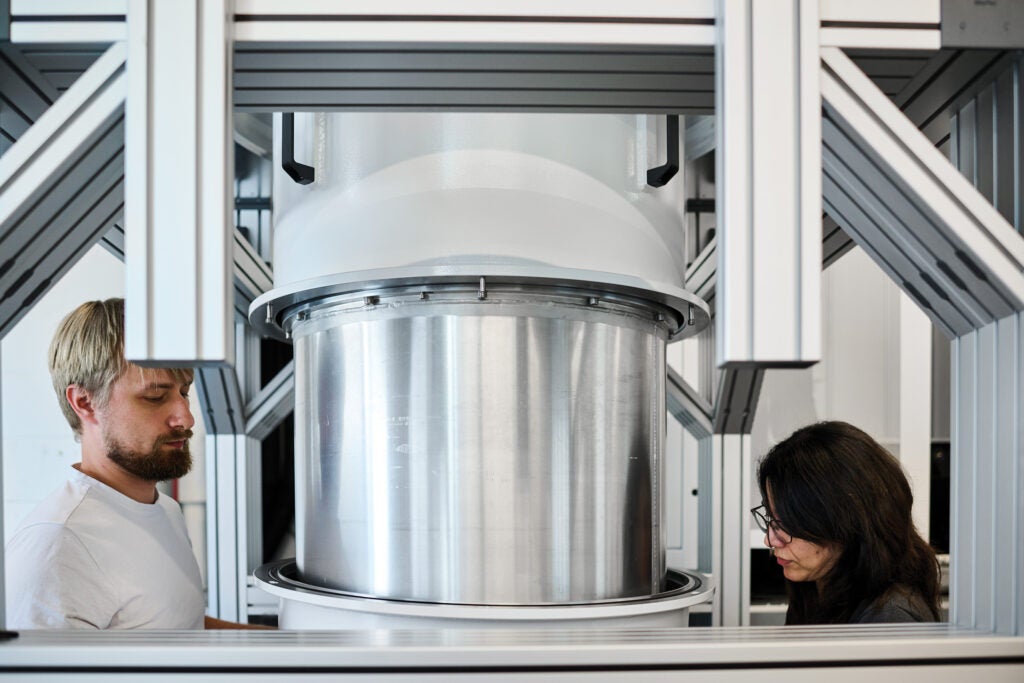
The Engine’s 150,000 square foot Cambridge, Massachussetts, building’s combination of wet labs and engineering prototyping spaces — filled with 3D printers, laser cutters, welding machines, and mills — makes it one of the few places in the world where these tough tech startups can go from plan to product.
The organization’s facilities and approach are rare for a reason, says Smith. “It is a tough business model,” he says with a laugh. “The teams we work with are in some of the most expensive industries you could try to break into. We are trying to make it less capital-intensive by building out these very technical lab spaces.”
Smith’s path to tough tech was decidedly nonlinear. An economics major at Sewanee | The University of the South, who didn’t take to finance, he did an about-face and became a director at a summer camp after graduation. He earned his MBA at Georgetown in part to help bridge his hard skills of operations and finance with his passion for mission-driven work. After his MBA, he ran operations at a Boston charter school — managing everything from budgeting to bus schedules. Long interested in impact, he was drawn to The Engine’s mission. “We have all these challenges in the world. You can pick up the paper any day, and you’re going to read about one of them,” says Smith. Climate change, poverty, public health, resource inequality — the list is endless, he says. “And it’s not always clear how you make an impact. So when I came here and saw these companies that are actually trying to tackle the world’s toughest challenges, I thought, ‘Oh, I see a role where I can have a large-scale impact on the world.’”
You can have the most promising idea in the world — something that people will throw a lot of money at… but if you don’t have the team and the leadership and the culture to support it long-term, it won’t scale or go anywhere.
– Rhett Smith (MBA’17)
One of the two major functions of The Engine, Smith says, is helping founders develop their ideas, providing them with the kind of programming necessary to help them turn their ideas into real businesses. There’s a bootcamp, for instance, that helps founders build a business model, says Smith, “and actually answer the question: Is entrepreneurship what I want to pursue right now? Or should I go take that job at SpaceX?” The other is running the incubator — and that’s Smith’s charge. “Everything that happens in our space — with all of the 113-plus teams in residency here — rolls up to me,” he says.
Startups rotate through The Engine every few years. What distinguishes the successful ones is usually the people rather than the technology, Smith says. “You can have the most promising idea in the world — something that people will throw a lot of money at. And that’s great, but if you actually don’t have the team and the leadership and the culture to support it long-term, it won’t scale or go anywhere.”
Smith loves the human aspect of the work. He’s in the office daily, meeting with the teams, touching base with the founders, and keeping the pulse of the organization. “Every day is very different, and that’s what I enjoy,” he says. “I also feel incredibly grateful that I get to do really exciting work — and work that has a mission that I can really relate to. I can see the impact every day.”
Hanging Tough – A Look at Some of The Engine’s Radical Residents
FORM ENERGY

A spinout from MIT, Form Energy is developing long-duration battery storage to make renewable energy scalable — an innovation that could transform the grid. “The biggest gap for renewables has always been storage,” says Smith. “If you don’t have direct access to wind or solar or some other energy source, how are you actually getting that to the grid?”
Form Energy has already built a 550,000-square-foot manufacturing plant in West Virginia (on the site of a former tin mill) and is potentially poised to become a market leader. “Battery storage has been a bottleneck in the energy sector for over a decade,” Smith says. “Form has actually developed technology that takes existing battery storage technologies on from the scale of hours of storage to days. And that level of magnitude is going to be a game-changer for the industry.”
FORAY BIOSCIENCE

What if you could grow building materials in a lab instead of cutting down trees? That’s the vision behind Foray Bioscience, which is creating lab-grown, tree-free cellulose materials as a sustainable alternative to wood. The result is cheaper, scalable, and significantly less carbon-intensive — with potential applications in everything from packaging to interiors.
“Foray can create materials at industry scale in labs, at 10x the efficiency of growing, and at fractions of the cost,” says Smith. Which immediately solves one of the biggest hurdles teams can face: Finding a market for their product. “It’s not about just saying ‘stop cutting down trees,’” Smith says. “It’s about offering the market something better — cheaper, more scalable, and more sustainable. That’s a no-brainer.”
ATLANTIC QUANTUM

Atlantic Quantum is a perfect example of the kind of innovation that can only happen at The Engine, says Smith. The startup is looking to accelerate the quantum computing revolution — with a focus on scalability and speed — but its work comes with incredible energy demands.
“If they were going to go build this company elsewhere, they would’ve had to take on about 50 times more space than they actually needed, because they needed so much power,” says Smith. “So they were going to get caught up in a situation where they didn’t have the capital to do this project and they couldn’t afford the real estate to even start it,” says Smith.
At The Engine, Atlantic Quantum operates in about 800 square feet of the 150,000 square foot building and yet it uses 30% of the building’s power. The company is using that energy to power three quantum computers, with a goal of getting to 12. “At that point, they want to start selling them,” says Smith. “And the power of quantum computing in the AI revolution is just being tapped.”
SUBLIME SYSTEMS

Concrete production alone is thought to be responsible for about 8% of global CO2 emissions. Sublime developed a new way to make cement using an electrochemical process that emits far less carbon while also offering a stronger product. Microsoft recently purchased 623,000 tons of Sublime’s product, signaling wider interest.
“Cement is not sexy. It’s not an industry that anyone’s ever going to talk about. But if you can eliminate that negative effect, you have made a huge impact on the climate while offering something that is just as effective — if not better — at a cheaper price,” says Smith.
Sublime is currently building out a facility in Western Massachusetts, where it hopes to eventually pump out 30,000 tons of cement per year. “It’s not our only focus to make Massachusetts a hub and prove that you can actually manufacture here, but that is a great byproduct of a lot of the work we do,” says Smith.
This story was originally featured in the Georgetown Business Fall 2025 Magazine. Download the Georgetown Business Audio app to listen to the stories and other bonus content.