The Power of Me: Defining Your Personal Brand
Jennifer Dalton on the importance of personal brand. Spoiler alert: it’s a must.
Jennifer Dalton (B’99, EMBA’12) grew up thinking about brand and reputation. Her parents were business owners, and Dalton knew early on what a company brand encompassed. Certainly branding in the traditional sense — logos, messaging, corporate identities. But later, in her Executive MBA classrooms, she started to notice something more personal at stake. Her classmates weren’t just trying to figure out their future career plans; they were asking existential questions: Who am I? What’s my story? Why would anyone want to follow me?
Today, Dalton helps executives, entrepreneurs, and teams answer those questions through her company BrandMirror. But her clients aren’t limited to entities and startups. Dalton urges anyone looking to build their career to focus on “personal branding” — not as a buzzword, but as a practical strategy for career growth and leadership.
“People follow leaders, not logos,” Dalton says. “Your personal brand is the story of your reputation and the promises you keep when others work with you.”
The term “personal brand” first became popular in 1997, when management guru Tom Peters coined the term in a Fast Company article “The Brand Called You.” Peters wrote “It’s time for me — and you — to take a lesson from the big brands, a lesson that’s true for anyone who’s interested in what it takes to stand out and prosper in the new world of work.” In today’s always-on, hyperconnected world, the stakes are even higher. According to Dalton, 40% of millennials say they check out a CEO’s personal brand before deciding to work at a company. “They want to know who I am working for and do I trust the direction and leadership of this company?”
Recruiters admit that a candidate’s online presence is often considered as an extension of their resumes. In truth, social platforms blur the lines between personal and professional: chances are, you already have a personal brand — whether or not you’ve built it intentionally.
Dalton puts it simply: “If you want to be seen, you’ve got to be consistent. Think of your personal brand like a heartbeat.”
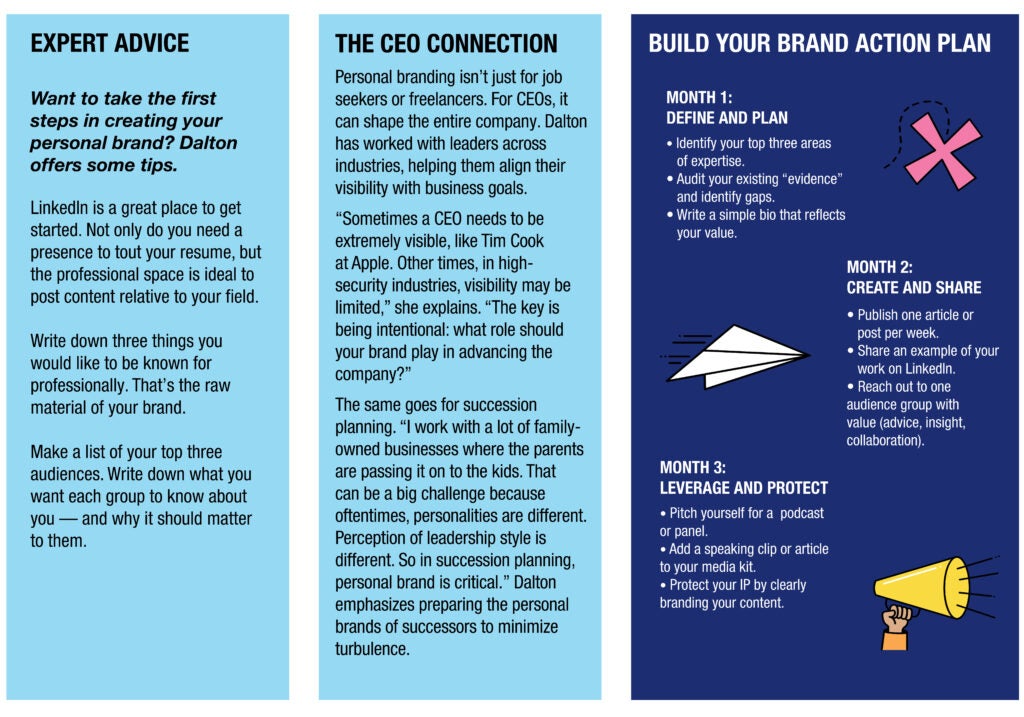
Dalton organizes the ongoing work of branding into three verbs: build, protect, and leverage. Build by continuing to create content, publish ideas, and showcase expertise. Protect by safeguarding your intellectual property — especially in a world of AI and content replication. Leverage by getting visible: pitch yourself for podcasts, volunteer for panels, or collaborate on projects.
It can be a tough road for those who like to hide behind our resumes — the idea of branding and marketing yourself might feel awkward, but that’s when Dalton suggests you call in your peers.
But in the end, Dalton insists, your personal brand isn’t a glossy veneer — it’s the sum of your choices, values, and follow-through. It’s how you show up, day after day, for the audiences who matter most in your professional world—and that is just the start. Like any good brand, a personal brand is never finished; it evolves as you do. “Your brand is alive,” says Dalton. “The question isn’t whether or not you have one — it’s whether or not you’re shaping it.”
Step 1: Define Your Core Expertise

The first step in building a personal brand is identifying what you bring to the table. Dalton asks her clients to narrow down their top three areas of expertise — not just based on their job title, but across their entire life journey. Those things can be examples from your work life, but they might also be from nonprofit work, volunteer work, or personal interests. “It’s not your job title, it’s your values, perspective, expertise, experience. How do you tell the story of your reputation?” Roughly 15% of Dalton’s Executive MBA class were transitioning out of the military, for example. That experience helped shape them — and should play a role in how they market themselves later.
Maybe you’ve led nonprofit initiatives, mentored others, or developed niche technical skills. “Not everybody is good at everything,” Dalton says. “You need to be able to say: here’s where I add value, and here’s what people can expect when they work with me.”
Step 2: Plan Your Way Forward

Once you’ve defined your expertise, the next step is proving it.
What would proof points look like for me? Dalton begins to ask: “What have you written about? Who have you spoken to? What projects show your skills? Then, based on where you want to go, what evidence is missing?”
If you want to be known as a thought leader, maybe you need more published articles. If you want to move into public speaking, you’ll need video clips.
She also talks with her clients about a reputation roadmap — what is it you want to be doing in 12 to 24 months? Then, Dalton says, we devise a strategy to get there. “A lot of times people will ask me, well, how long does it take to build a personal brand?” says Dalton. “Even if you’re head’s down in your work and you really haven’t built an online or LinkedIn presence yet, it really takes at least three to six months to build enough evidence to be more visible.” For CEOs and high-ranking c-suite executives, that time frame can double.
“Telepathy is not a strategy,” Dalton says. In other words, you can’t expect people to just know what you’re good at. You have to show them.
What does that look like, brass tacks?
Say I’d like to be a speaker at a writers conference. My roadmap might include actionable steps like publishing three LinkedIn articles to my profile, appearing on two podcasts, and networking with conference organizers six months in advance.
“The key is consistency,” Dalton says. “A single LinkedIn post won’t make you a thought leader. Just like your heart beats regularly, your brand has to show up regularly.”
Step 3: Know Your Audience

Here’s where most people are surprised, says Dalton. 90% of personal branding isn’t about you. It’s about your audience. “Who needs to know you exist?” she asks. “And why should they care?”
Your audience could be potential employers, clients, collaborators, or even peers in your field. Each group may need to see you in a slightly different way.
When asked about her own brand, she doesn’t hesitate. “My expertise is strategy, clarity, and structure,” she says. “I love helping clients see themselves more clearly and get excited about their own value.”
Interestingly, Dalton notes that younger generations, who tend to be more comfortable sharing online, are already immersed in branding, sometimes without realizing it. But intention matters. Personal branding to Dalton, is not optional. “Whether you’re shaping it or not, you already have a brand,” she says. But, is it the one you want? An audit of your online presence and interactions will help. And you can always ask professional peers or friends (part of your audience) what strengths they see in you. “You should never do your own personal brand by yourself for a lot of reasons,” says Dalton, “but mainly because no one likes thinking about who they are in a vacuum.”
Once you identify core audiences, it’s time to put yourself out there. But, of course, there are pitfalls. Dalton points out the two she sees most often: inconsistency and clients who confuse branding with bragging, offering no value in their content. So letting people know you got a promotion is grand, but better might be to couch that good news in a post that offers viewers something more. In my case, as a writer, that might be to share my good news while posting my latest article on personal branding for Georgetown Business. Ask yourself this question says Dalton: What does consistency and credibility look like for me and for my audience?
Step 4: What’s Your Special Sauce?

Defining your expertise is one thing. But Dalton emphasizes the importance of designing your brand in a way that makes you stand out. She breaks it down into three levels: Functional (what you literally do for a living — your skills and services); differentiation (what makes you unique — what’s your “special sauce?”); emotional (how people feel after interacting with you).
“A really good brand connects emotionally as well as functionally,” she says. Think Patagonia, which sells outdoor wear but also delivers a sense of purpose. Or Chick-fil-A, whose service experience is so consistent that you always know what to expect. For individuals, differentiation could be your leadership approach or even your sense of humor.
This story was originally featured in the Georgetown Business Fall 2025 Magazine. Download the Georgetown Business Audio app to listen to the stories and other bonus content.