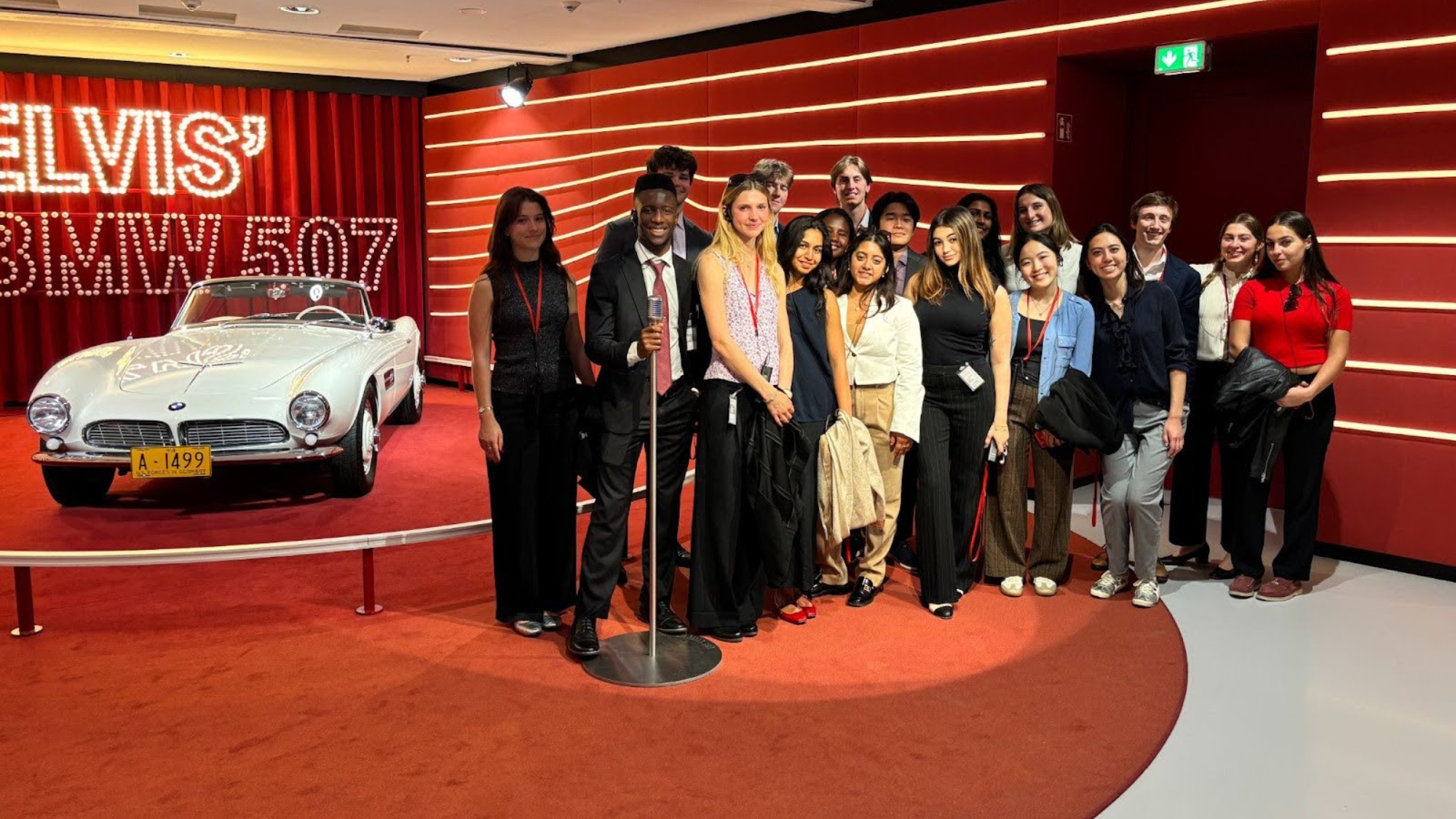
Izmirlian Students Traverse Continents for Insight into BMW’s Value Chain
Tosin Fagbami (BGA’26), a McDonough Student Ambassador, is a rising senior in the Dikran Izmirlian Program in Business and Global Affairs (BGA). As part of the third-year curriculum, Fagbami and her classmates recently followed the BMW supply chain, traveling to Germany, South Carolina, and Mexico.
My Journey to Georgetown and the Izmirlian Program
Thinking back to my college application process at the tail end of the pandemic, I remember the overwhelming uncertainty that consumed my life. The world felt unsteady, defined by remote learning, disrupted routines, and a constant sense of unpredictability about what came next. Like many students at the time, I wasn’t just questioning where I’d go to college — I was questioning what kind of future I’d be stepping into. It was this volatility that drove me to seek an education that was nuanced and would equip me with the tools to not only understand the uncertainty of the present, but to take on an increasingly global future.
I knew from the second I heard about the Izmirlian Program in Business and Global Affairs program that it was exactly everything I was looking for, wrapped up with a bow: incredible professors, a close-knit community, and courses structured to address a rapidly changing global landscape. Looking back now at my three years at Georgetown, despite the jet lag and challenging projects, joining this cohort was one of the best decisions I have ever made.
The Global Value Chain Experience
When I told my dad I would be traveling around the world with BMW for two and a half weeks, he jokingly asked if I’d get to test drive a Beamer. While I didn’t get behind the wheel, what I gained was far more valuable: an inside look at how one of the world’s leading automakers thinks about sustainability, strategy, and scale.
The lead up to the first of eight flights was no picnic. My team and I were assigned a project focused on electric mobility and trade: How can BMW ensure a reliable supply of key components — such as battery cells and storage systems — in the United States, while accounting for political, logistical, and technical constraints? And more importantly, what strategies could help overcome the challenges of high production costs and regulatory requirements?
As someone who had absolutely no idea how batteries actually work, the question was daunting. How was I supposed to become an expert in electric vehicle battery manufacturing over the course of the two months before we flew to BMW headquarters? Despite the challenge, our team worked to put together a preliminary analysis and a hypothesis we would test over the course of our trip.
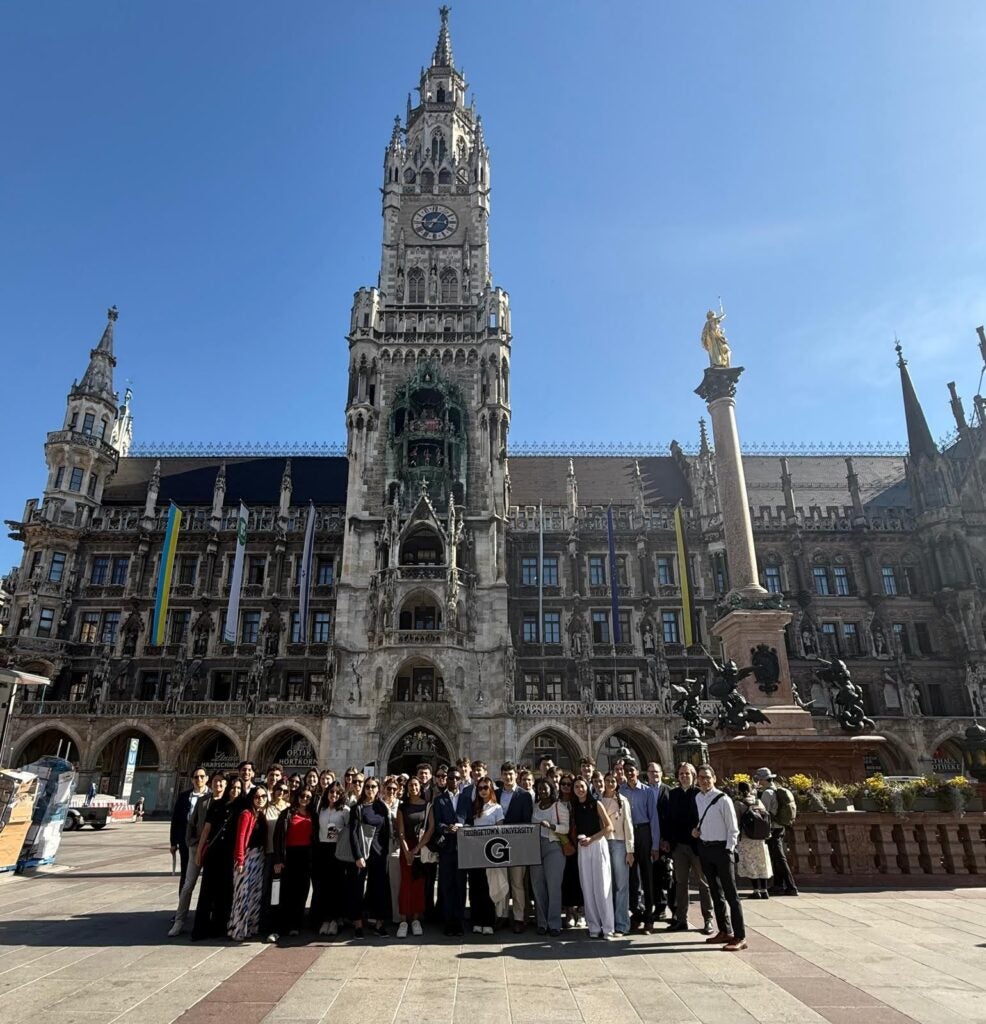
Izmirlian students in front of the old town hall in Munich
Munich and Berlin, Germany
Our time at each of the three sites we visited was divided into two segments, each with a distinct focus. The first segment centered on understanding BMW as a company — its operations, priorities, and global challenges. The second explored the dynamic between the public and private sectors, highlighting how government policy and corporate strategy intersect.
The first leg of our time in Germany was spent in Munich — BMW’s longtime headquarters and origin. During our first couple of days in the city — beyond acclimating to the time difference — we spent most of our time at the BMW headquarters near the Munich Olympic Park. Each day offered us unprecedented access to the company’s teams, employees, and executives, all of whom were generous with their time, knowledge, and, above all, honesty. It was refreshing to hear supply chain teams discuss the difficulties of controlling and streamlining hundreds of first, second, and third-tier suppliers and the realities of an uncertain U.S. trade environment. Our teams took full advantage of these conversations to learn as much as possible about topics within and outside the scope of our projects.
We also got a chance to step outside of the offices and explore the BMW factory in Munich. It was incredible to walk around the huge plant with our hard hats and watch employees and machines working in tandem to produce the vehicles we had read so much about.
As someone who opted not to study abroad, traveling to Munich presented not only an incredible opportunity to learn more about BMW’s supply chain from leadership at the company, but also a chance to explore a city I had never been to. I loved our fireside chat with BMW Board Member Ilka Horstmeier, but one of my favorite moments was an incredible dinner and even better conversation with young BMW employees and students from Hochschule für Philosophie München and Stiftung Bayerische EliteAkademie, two Universities in Munich. We discussed everything from energy and social policy to career paths and personal ambitions. It was by far one of the most meaningful and thought-provoking nights of the trip.
Although our time in Berlin was much shorter than our stay in Munich, it provided an incredible opportunity to learn more about German politics and the interactions between the public and automotive sectors in a country that has such a rich manufacturing history. Speaking to Bundestag (German Parliament) members and visiting the U.S. embassy were two highlights of my time in Berlin. We were also given one day in the city with no programming, and it was amazing to walk around and visit historic sites such as the Berlin Wall, which I had only ever seen pictures of.
Spartanburg and Columbia, South Carolina
Our time in South Carolina was brief — just three days, including travel, but incredibly valuable. It was fascinating to compare the factory operations and workplace culture we experienced in Munich with those at the Spartanburg plant, the largest BMW manufacturing facility in the world.
The time we spent in Columbia provided some insight into how state-level governments balance the goals of their constituents with the interests of multinational organizations, such as BMW. It brought me back to the intro course, Global Markets and Politics. In that class, we focused on understanding the theories behind voter behavior and political leaders, but speaking to the South Carolina Department of Commerce added color and nuance to what we studied in class.
San Luis Potosi and Mexico City, Mexico
Mexico was our final stop on the BMW global value chain tour, and while I genuinely enjoyed every city we visited, San Luis Potosí and Mexico City easily had the best food. We began in San Luis Potosí with a tour of BMW’s manufacturing plant. Given this wasn’t our first factory visit, it was fascinating to compare the different technologies and production processes used at each site. During our time there, we spoke with BMW executives who shared candid insights into the company’s challenges in Mexico, from workforce development to navigating political and regulatory landscapes. It became clear just how deeply local context shapes global strategy.
After San Luis Potosí, we took a short flight and a very long bus ride to Mexico City. There, we had the opportunity to meet with Pedro Casas Alatriste (MPP’22), who previously served as a teaching assistant for the Izmirlian Program and is now the executive vice president and CEO of the American Chamber of Commerce of Mexico. His candor about U.S.-Mexico relations and the importance of cross-border collaboration aligned perfectly with many of the themes our cohort has explored in class and during our travels.
On our free day in the capital, I visited the Palacio de las Bellas Artes, where the murals by iconic Mexican artists blew me away. It was a great chance to practice our Spanish and soak in the local culture. We wrapped up our time in Mexico with an alumni dinner — filled with good food, great company, and thoughtful conversations with past Hoyas.
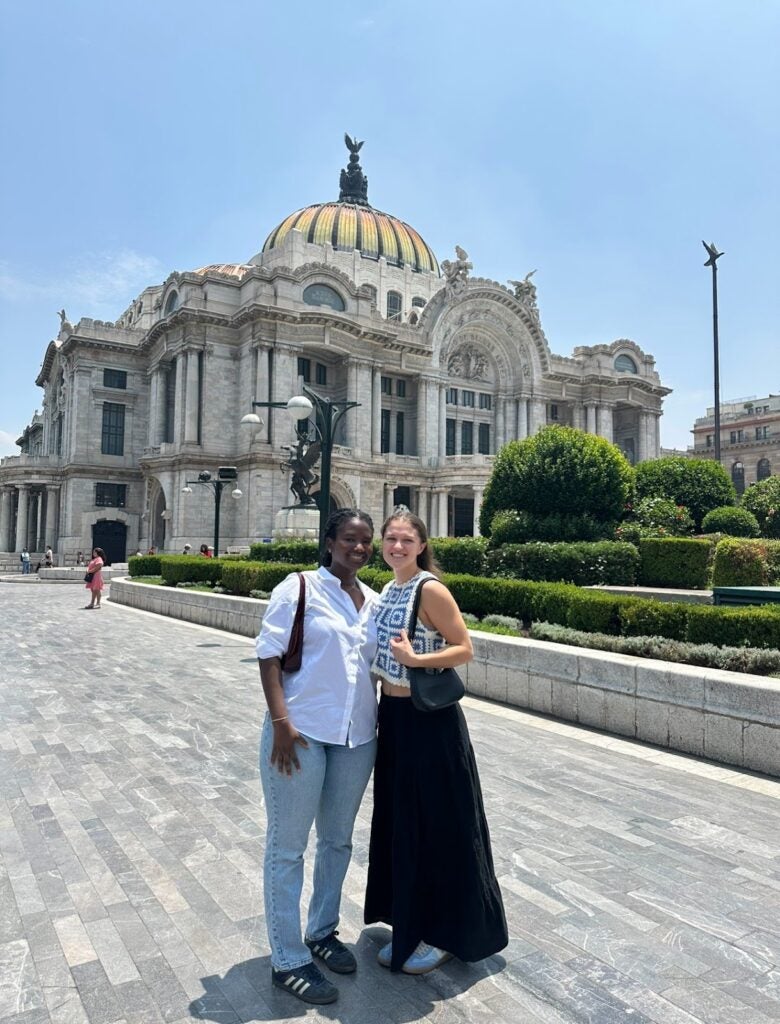
Fagbami and classmate at Palacio de las Bellas Artes in Mexico City
Putting It All Together
Sitting down with my group at a small booth in the Hariri Building after the whirlwind of customs, flights, and buses felt surreal. We looked through the presentation we created together before leaving the country and, despite the jet lag, we were excited to put everything we had learned into our final presentation. 48 hours later… we were done, and our global value chain experience officially came to an end. We recognized that BMW’s battery supply chain would require risk mitigation to ensure electric mobility growth and proposed a two-pronged approach to address those challenges.
Reflections
As our cohort came together to prepare small tokens of appreciation for our professors — Mario Ramirez, Brad Jensen, and Andreas Kern — and for the incredible support staff – Kelly McGrath and Wilbert Hidalgo — I found myself reflecting on just how transformative our trip was. Yes, it was an incredible educational experience filled with challenges, curiosity, and growth. But what struck me most at that moment was how much we had changed, too. Looking around that room, I realized our cohort had grown into a team — more confident, more connected, and better equipped to take on the complexities of the global future we came here to understand.
At the end of this project, I can confidently say I know more than I ever wanted to about electric vehicle batteries. But more importantly, I have walked away with a deeper understanding of the systems, people, and decisions that keep the global markets running. I came to Georgetown with a desire to create certainty in an increasingly uncertain world. The truth of the matter is that uncertainty isn’t going anywhere, but this trip truly highlighted that the goal isn’t to eliminate uncertainty — rather be prepared to lead through it.
-Tosin Fagbami (BGA’26)
Related Stories

Business and Global Affairs
Izmirlian Program Students Engage with Key Stakeholders in Ghana
Business and Global Affairs, Events
Izmirlian Students, Business Leaders Discuss Digital Transformation at Business and Global Affairs Conference