What’s Next for the Future of Global Business? Baratta Center Conference Reimagines the Answer
There was a spirit of open discussion and cross-sector engagement in the room at the third annual Future of Global Business Conference that reflected a broader truth: progress in global business will depend on dialogue, collaboration, and collective problem-solving across borders and industries.
The conference, hosted by the Baratta Center for Global Business Education, fosters learning from business executives, ambassadors, policymakers, and thought leaders of the day. In his opening remarks, Anil Khurana, executive director of the Baratta Center and research professor at Georgetown’s McDonough School of Business, set the tone for this year’s session. “If there’s one key question we are going to try to address today, it is ‘what does the future of business look like?’” Underlining the role of the Baratta Center in shaping business leaders of the future who can think across borders, navigate complexity, and act with purpose, he summarized the objective behind organizing the conference: “The goal isn’t to just understand global business,” he argued, “but to shape it.”
The speakers — from the former U.S. Commerce Secretary to ambassadors and CEOs — kept returning to the same compass: let markets lead, step in with industrial strategy actions only for genuine security considerations, move with allies, and execute close to the customer. Simply put, strategy today must learn to abide by two key principles: set sharp priorities and make decisions that hold up in a world in flux, while maintaining a high degree of agility and adjustment.
Business, Policy, and the Global Agenda
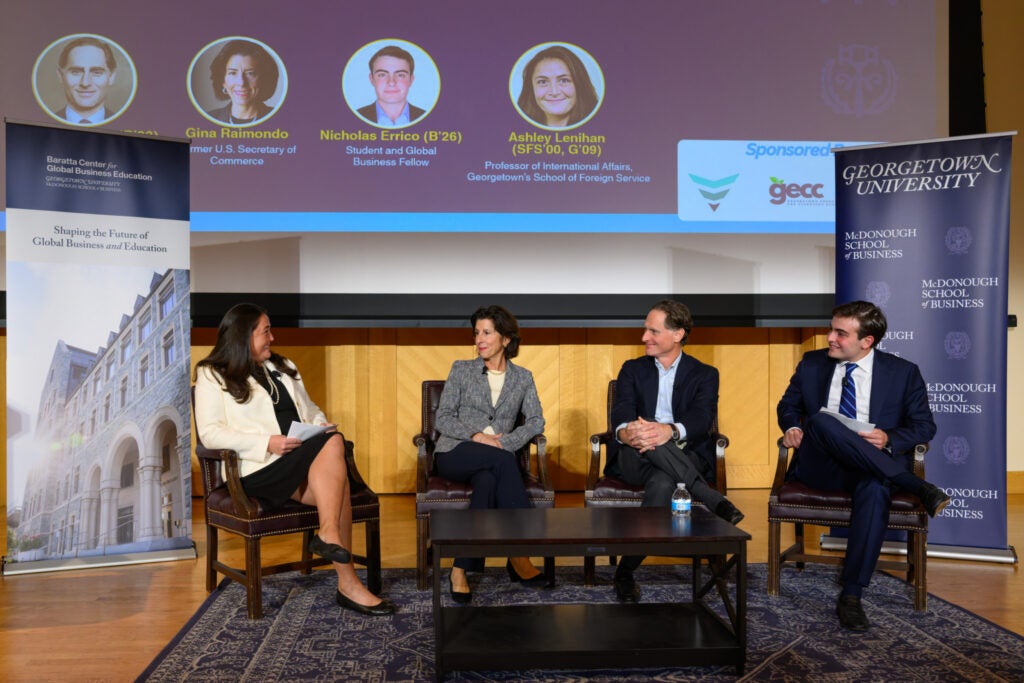
Ashley Lehihan (left), Gina Raimondo (center left), Joe Baratta (center right), and Nick Errico (right) during Fireside Chat at Baratta Center conference | Photo Credit: Rafael Suanes/Georgetown Univ.
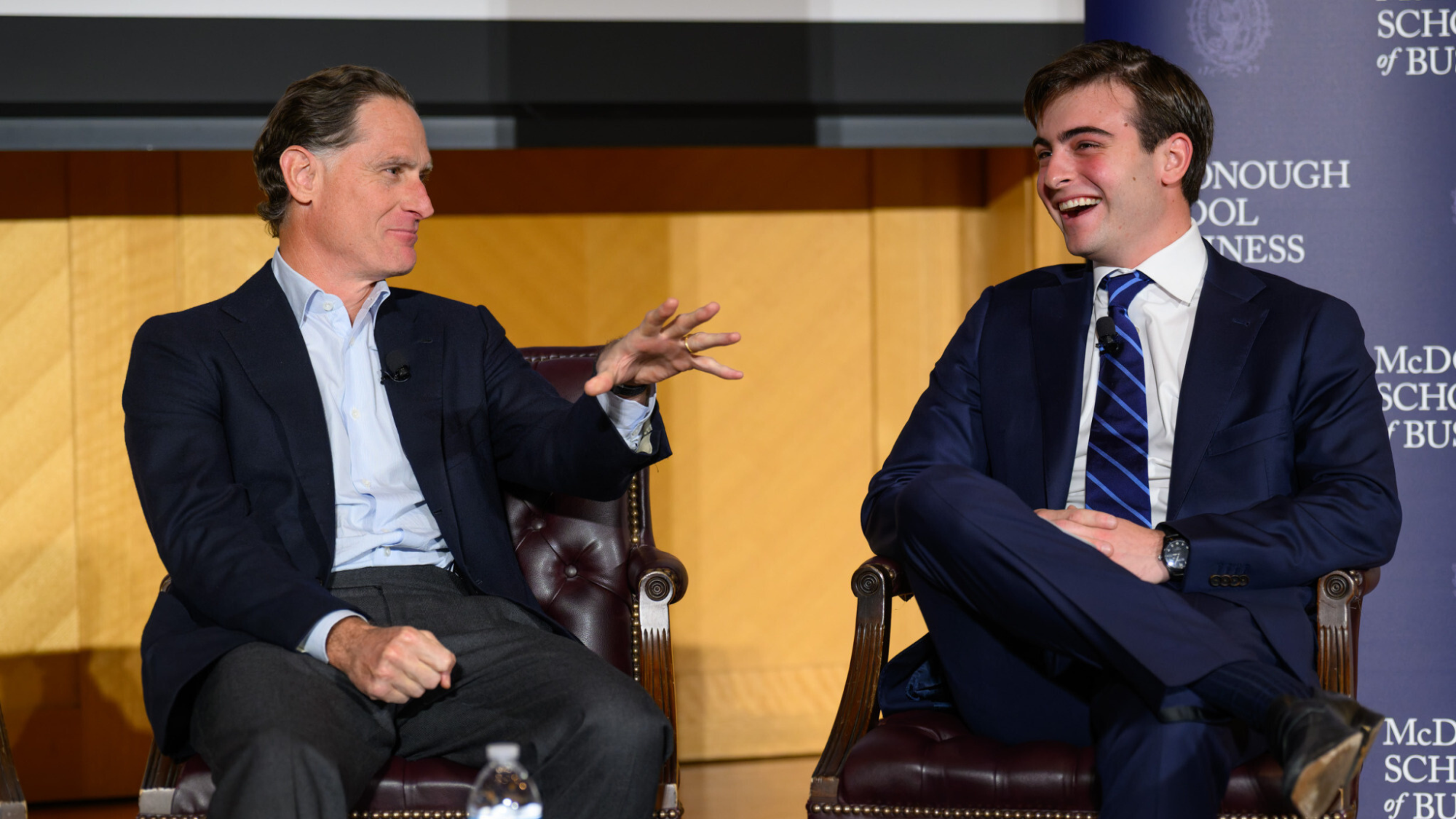
The conference opened with a fireside chat between Joseph Baratta (B’93), global head of private equity strategies at Blackstone, and Nicholas Errico (B’26), student and Global Business Fellow at the Georgetown McDonough. Reflecting on the rise of artificial intelligence (AI) vis-à-vis the global economy, Baratta argued that AI’s increased capabilities will only make us all “better, faster, smarter, and more efficient” over the long run, and allow us to address some of the most pressing challenges facing humanity. When it comes to training, he advised, “Get your foundational skills, learn how to engage with people, and then look for where the world is going.”
The two were joined on stage by former U.S. Secretary of Commerce Gina Raimondo and Ashley Lenihan (SFS’00, G’09), professor of the practice of international affairs at Georgetown’s School of Foreign Service, who moderated the rest of the talk. The discussion pivoted to industrial policy in the present-day geopolitical context.
“In general, I favor the government having a pretty light touch into the market,” said Raimondo. “But, the market prioritizes profits, not national security.” She pointed to the CHIPS and Science Act as the exception. She noted that before the CHIPS Act, “there was not a single AI chip made in this country… they were all made in Taiwan.” That exposure, she argued, justified CHIPS-era intervention. “If it’s a clear national security need, then the government ought to intervene. But short of that,” she said, “it risks doing more harm than benefit.”
From the private-capital side, Baratta agreed on the boundary. “I don’t think governments are the best allocators of capital. We have to do what Gina did in the CHIPS Act to survive as a sovereign.”
When discussing export controls, Raimondo emphasized taking a global approach.
“These sorts of export controls really only work when you do it with your allies. If China can buy something from Europe, it makes no sense for us to deny them,” she said.
The conversation then moved back to AI. Raimondo was quick to separate froth from fundamentals. “The equity market may be in a bubble, but the technology is here to stay. Every business has to use [AI],” she argued.
The bottleneck, however, is energy and permits. “You can’t do anything without electricity. It takes seven, eight, nine years to connect to the grid,” Raimondo said, calling today’s interconnection and permitting timelines untenable, making a case for the simplification and streamlining of processes to enable maximum efficiency.
What is Diplomacy’s New Job Description?
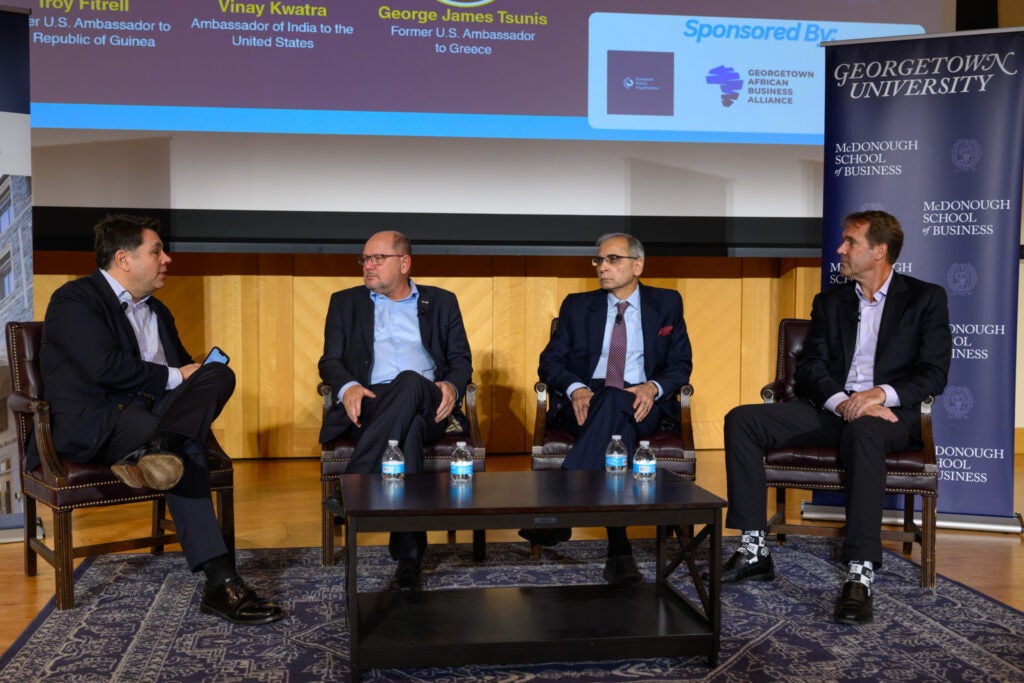
George Tsunis (left), Urban Ahlin (center left), Vinay Kwatra (center right), and Troy Fitrell (right) during ambassador panel at Baratta Center conference | Photo Credit: Rafael Suanes/Georgetown Univ.
Following the fireside chat, George James Tsunis, former U.S. ambassador to Greece, moderated a panel discussion with Urban Ahlin, ambassador of Sweden to the United States; Troy Fitrell, former U.S. ambassador to the Republic of Guinea; and Vinay Kwatra, ambassador of India to the United States. Together, they framed geopolitics as increasingly commercial and transactional. Ahlin described “a total rupture of the system that we have had so far,” urging openness where countries are complementary.
On the question of increasing tensions and strife on the global stage, the Swedish envoy urged democratic alignment, arguing that nations with shared values should join forces” because their motivations differ fundamentally from “authoritarian regimes.” On defense, Ahlin feels the European Union is stepping up its game. “I have no doubt that most of the European countries will actually reach five percent before the United States meets five percent,” he said, referring to the commitment from NATO nations to increase their defense spending to five percent of their GDPs by 2035. He tied this principally to Russia and regional instability. “We see a threat. We see the Russian invasion of Ukraine. We see what is happening in our own neighborhood.”
For his part, Kwatra leaned into pragmatic rule-setting. Countries, he argued, will build their own AI stacks for now, but past fights over “multilateral vs. multi-stakeholder” internet governance foreshadow the debate to come. On the question of how he viewed the India-U.S. relationship, Kwatra emphasized that the two democracies are complementary in terms of common goals and objectives.
On the popular topic of critical minerals, Fitrell argued companies can no longer assume rational economic behavior from geopolitical competitors. “China built 200% of the world’s copper-processing capacity, not because it needed the copper, but to make it fundamentally incalculable for Western companies to invest,” he noted.
Leading in an Unprecedented Era of Global Business
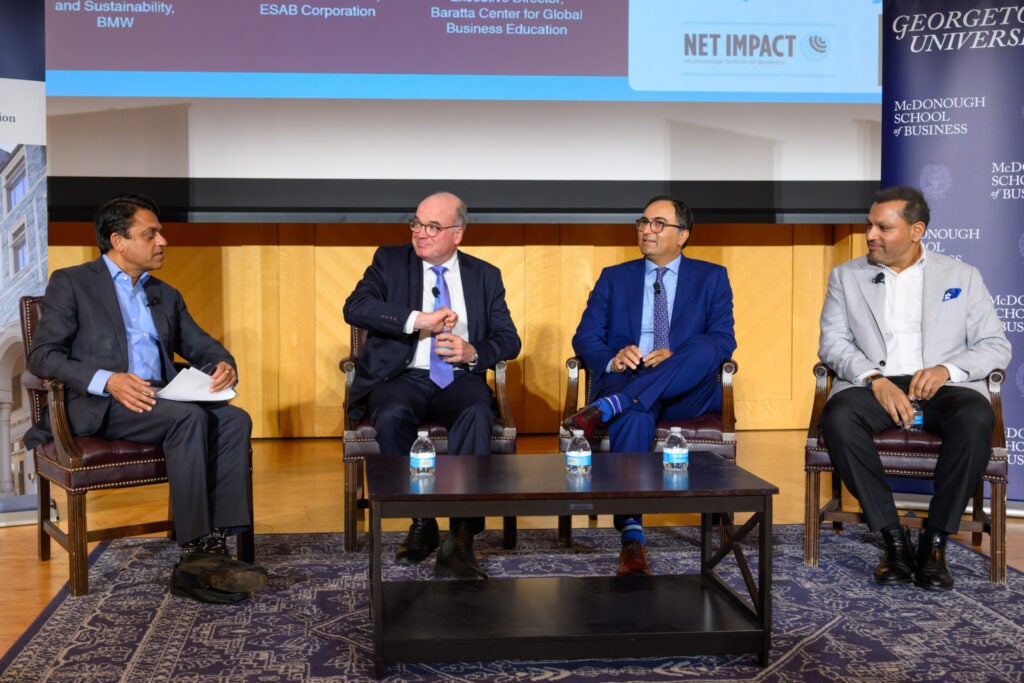
Anil Khurana (left), Thomas Becker (center left), Shyam Kambeyanda (center right), Reggie Aggarval (right) during CEO panel at Baratta Center conference | Photo Credit: Rafael Suanes/Georgetown Univ.
For the final panel of the day, Khurana moderated a panel featuring Reggie Aggarwal (L’99), CEO of Cvent; Shyam Kambeyanda, president and CEO of ESAB Corporation; and Thomas Becker, head of external affairs and sustainability at the BMW Group. The key takeaway from the session: build for local execution, optionality, and talent that can flex.
Kambeyanda traced a personal arc through globalization, from India to the United States to Europe and China, and the pivot he’s managing now. “What we’re fundamentally navigating today is a new world [that is] a lot more nationalistic, where you’re almost going to be required to produce in the place where you do business,” he said.
He then sketched ESAB’s operating model for resilience. “Almost 85% of our product is actually produced in the region it’s sold, run by local talent.” That footprint gives the firm “a unique position where it won’t matter who wins” regionally.
Becker offered the automaker’s view of complexity management. “What a carmaker does is system integration. It is not making a product yourself. It is about putting things together. We have roughly 9,000 direct suppliers around the world,” he said. So, don’t wait for certainty. “One of the biggest risks is believing that governments will create anything like planning certainty. You better prepare for things being contradictory.”
On climate, BMW is steering for compliance with the Paris Climate Agreement. The company plans to reduce carbon use from ~150 million tons in 2019 to 110 in 2030 — even while confronting recent-day uncertainty in the domain of government support for clean-energy use.
Speaking about what he expects will dominate the future of global business, Aggarwal had a two-part answer: AI and people. He described AI as “the single most important factor” set to reshape every aspect of global business over the next three to five years, emphasizing that its impact would extend far beyond the software sector. “Every board is telling every CEO, and every CEO is telling every leadership team… [about] 80% of all industries are saying that that’s the number one issue we’re dealing with.”
Equally central, in his view, is talent. “I spend 40% of my time on people,” he noted, explaining that the right hires drive everything a company can achieve. Linking this back to AI, Aggarwal stressed that the real challenge — and opportunity — lies in weaving AI into everyday workflows. “Talent is shifting very dramatically,” he said, arguing that the future will belong to those who can pair hard-to-teach critical-thinking skills with fluency in using AI tools to generate value and drive growth.
– Akash Chowdhury (G’29), Baratta Center Student Fellow
Related Content
Alumni, Jesuit Values
Baratta Center Announces Winners of 2025 Global Impact Award
Business and Global Affairs, Events
Baratta Center Discusses Global Competition and Collaboration During Annual Conference