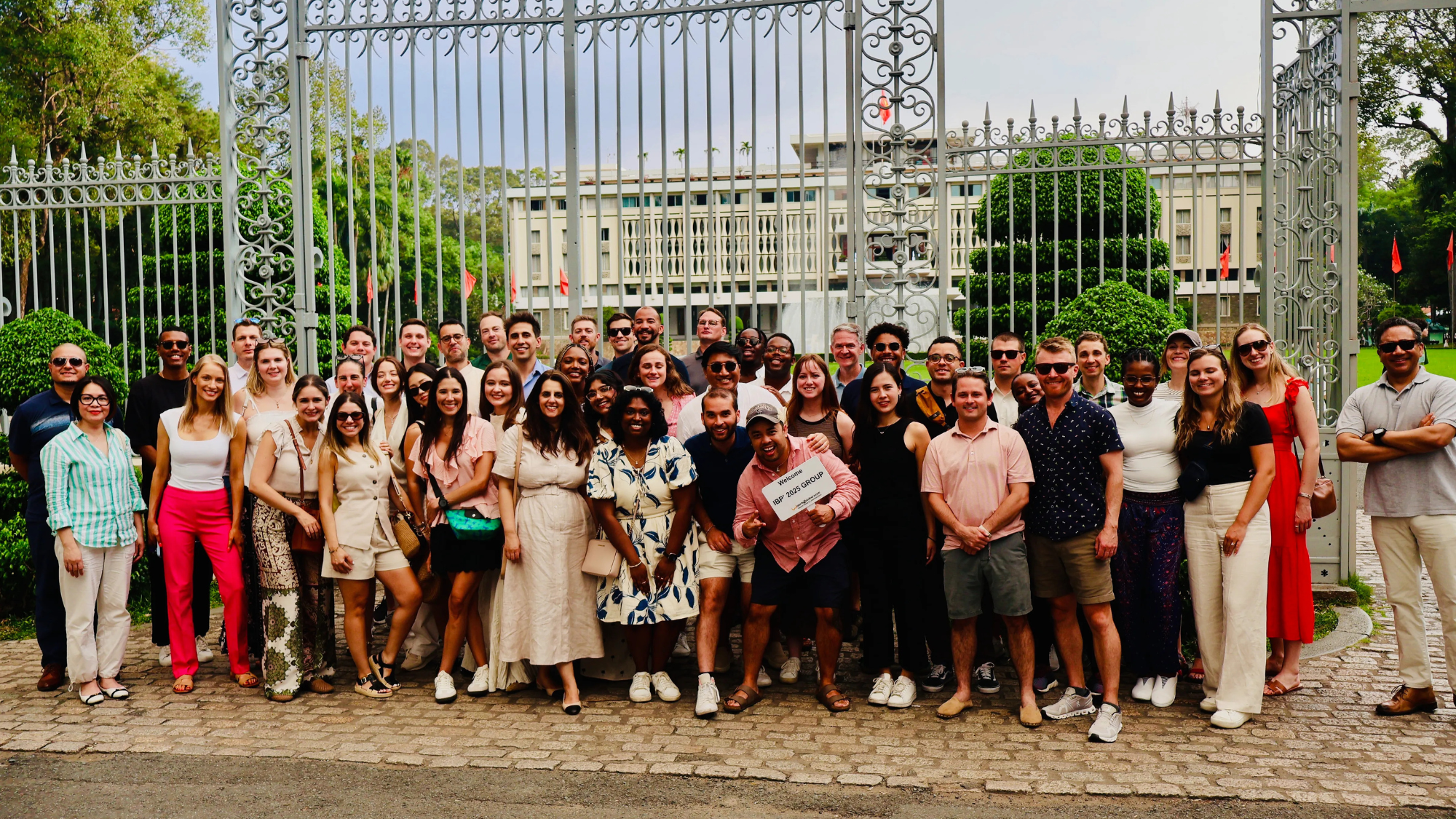
Dispatches From Vietnam: Bridging Theory and Practice Through IBP Residency
This story is part of the Student Voices series, which provides a firsthand perspective of the student experience at Georgetown McDonough. Margo Spiritus (IBP’25) is a student in the Master of Arts in International Business and Policy (IBP) program and a McDonough Student Ambassador.
Lessons from the Heart of Asia’s Growth Engine
We just returned from our transformative week-long residency in Ho Chi Minh City and are all still buzzing with ideas and memories. For a program built on the dual DNA of business and policy, Vietnam was the perfect classroom. With its profound history and rapid transformation into one of the world’s fastest-growing economies, Vietnam sits at the epicenter of global supply chain realignment, shifting dynamics in international trade, and a surge of innovation and entrepreneurial growth.
During our stay, we devoured street food, clung to the backs of scooters, walked across chaotic intersections (pro tip: don’t stop, just keep going), and dove into the city’s night markets. It was extraordinary in every way. Of course it wasn’t all phở and fun; we packed in rigorous coursework, eye-opening site visits, dynamic guest speakers, and an unforgettable trip to the Mekong Delta.
The timing of our trip couldn’t have been better. We arrived as supply chains were realigning, tariffs were reshaping global trade, and the international order was undergoing fundamental shifts. Vietnam sits at the center of all these forces, benefiting from manufacturing migration, navigating great-power competition, and charting its own path. Its recent GDP growth of 7.25% (the highest in 15 years) isn’t just a statistic – it’s the outcome of strategic policy choices, demographic and geographic advantages, and savvy positioning in a multipolar world. Being there meant seeing these macro trends come alive in high-tech factories, gleaming office towers, and the energy all around the city.
Academic Deep Dive: Three Lenses on Vietnam’s Success
Our academic program was structured around three complementary perspectives, each offering crucial insights into Vietnam’s remarkable trajectory.
Comparative Politics and Development Economics
Professor Raj M. Desai
This course explored the central question of why some countries grow wealthy and stable while others remain impoverished and volatile. We examined everything from why markets fail and how institutions shape opportunity to the role of governments in development, along with the impact of inequality, resources, and conflict. Vietnam, as an emerging economy undergoing rapid change, served as a living case study that highlighted both the opportunities and challenges of growth.
Organizational Management and Cross-Cultural Negotiation
Professor Brooks Holtom
In a world where business and policy increasingly cross borders, understanding how culture shapes negotiation is a critical skill. This course offered a framework for navigating cultural differences at the bargaining table, not through country-specific customs, but by examining how interests, strategies, and contexts shift across cultures.
Through a mix of theory, case studies, and hands-on simulations, we explored how decision-making processes affect negotiation outcomes and practiced applying principled negotiation frameworks in diverse settings. The course challenged us to expand our toolkit of strategies so we could adapt to different cultural dynamics, resolve disputes, and drive effective decision-making in both domestic and international contexts.
Challenges and Opportunities in Emerging Asia
Professor April Nguyen
This course examined Vietnam’s integration into global markets, highlighting both market and non-market factors that shape its rapid development. Through company visits ranging from tech unicorns to manufacturing and electronics firms, alongside discussions of history and policy, we gained a firsthand look at how globalization plays out on the ground. The experience provided a comprehensive understanding of the strategies needed to navigate growth, risk, and transformation in a dynamic economy.
Company Visits
Digital Future
Our visit to VNG Corporation, Vietnam’s first tech unicorn, offered a front-row seat to the country’s digital transformation. Launched 20 years ago as a PC games publisher, VNG has evolved into multiple business units including Zalo (Vietnam’s WhatsApp) and its fintech arm ZaloPay. It has become a household name while navigating the challenges of scaling in a competitive regional market. Conversations with executives revealed what it takes to compete against global giants: a deep understanding of local consumer behavior, a strategy rooted in Vietnam’s unique digital ecosystem, and a constant battle to attract and retain top tech talent. VNG’s story reflects Vietnam’s broader ambition to not only participate in the digital economy but to lead it.
Moving Up the Value Chain
At Framas, we walked through how the company has evolved from a supplier of shoe components to a precision manufacturing powerhouse serving Adidas, Nike, Puma, and New Balance. On the factory floor, we saw advanced automation working alongside skilled Vietnamese workers, producing components that meet the strict standards of the world’s biggest sports brands. Our discussions underscored how success requires more than efficiency — it depends on workforce development, cultures of continuous improvement, and maintaining global competitiveness without compromising quality.
Swiss Precision in Vietnam
At Cicor Group, we met with Luat Nguyen, managing director of Cicor Vietnam, who described his company as a living case study in how Vietnam is becoming a rising tech powerhouse. Cicor specializes in electronic manufacturing services (EMS) for industries where precision is non-negotiable, automotive, industrial, and medical. Nguyen shared Cicor’s mission:
Advancing digitalization in EMS
Managing talent in the age of People 4.0
Building an ESG journey rooted in responsible manufacturing
Scaling globally while staying agile and resilient
As he put it, “This isn’t about product specs or tariff codes. It’s about vision, strategy, and execution in a fast-changing world.” Nguyen’s message was clear: Vietnam is no longer a low-cost manufacturing hub, it is emerging as a strategic player in the global value chain.
A U.S. Perspective
We also had the opportunity to meet with Matthew Kustel, economic officer at the U.S. Consulate in Ho Chi Minh City. His briefing added an important policy dimension to our business-focused visits, highlighting the broader context of U.S.–Vietnam economic relations, opportunities for partnership, and challenges of navigating trade, investment, and regulatory landscapes. Hearing directly from him underscored how diplomacy and business strategy intersect in shaping Vietnam’s role in the global economy.
Challenges on the Horizon
Our academic program also highlighted the significant challenges Vietnam faces as it pursues its development ambitions:
Middle-Income Transition: Moving from middle-income to high-income status requires fundamental shifts in productivity, innovation, and value creation, transitions that have stymied many countries.
Environmental Sustainability: Rapid industrial growth has created significant environmental challenges that could constrain future development if not addressed systematically.
Geopolitical Navigation: Balancing relationships with major powers while maintaining strategic autonomy requires increasingly sophisticated diplomacy and economic statecraft.
Reflections
Vietnam offers a masterclass in strategic development, pragmatic governance, and the complex interplay between domestic choices and global forces. The country’s journey to a dynamic emerging market provides invaluable lessons for understanding the drivers of sustainable development. Vietnam isn’t just a study abroad program; it’s a glimpse into the future of global business.
-Margo Spiritus (IBP’25)