IBP Students Gain Real-Time Insights on Global Security and Policy at NATO in Brussels
This story is part of the Student Voices series, which provides a firsthand perspective of the student experience at Georgetown McDonough. Margo Spiritus (IBP’25) is a student in the Master of Arts in International Business and Policy (IBP) program and a McDonough Student Ambassador.
To study deterrence and the security dilemma in a classroom is one thing. To walk into the North Atlantic Treaty Organization (NATO) headquarters while those same ideas are being tested in real-time is quite different.
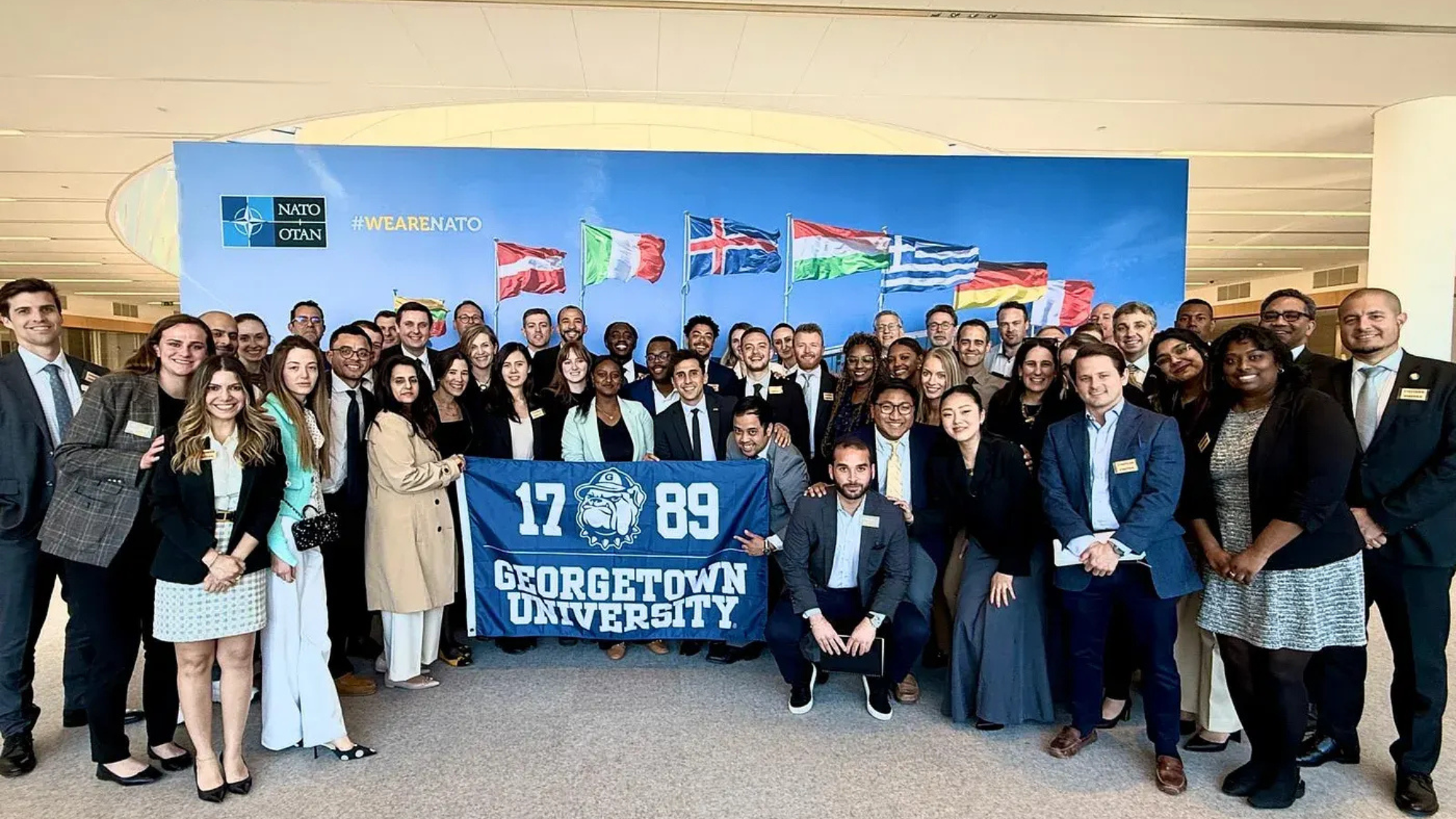
As part of Georgetown’s Master’s in International Business and Policy (IBP) program, a joint degree from the McDonough School of Business and the School of Foreign Service, we spent a full day at NATO. The visit was part of Professor David Edelstein’s course on Diplomacy, Institutions, and International Business.
Insight from NATO Leadership
This wasn’t a tour or a talk. It was a full day of briefings and deep dives with both NATO and country team members who have spent their careers navigating defense, diplomacy, and the frontlines of conflict. The day began with a sobering tone – the war in Ukraine, Russian aggression, and the role of NATO, from collective defense to strategic coordination. We continued with conversations with NATO’s assistant secretary general for operations about security, nuclear deterrence and command and control, and spent time with the first secretary of the U.S. Mission to NATO, who broke down the politics of the alliance, how decisions get made, and how 32 member countries (all with their own agendas) attempt to move as one.
The High North Challenge
In the afternoon, our cohort took the lead. We stepped into the role of NATO ambassadors in a live simulation, a session to determine whether the alliance should develop and adopt a formal High North (Arctic) policy. Backed by insights from earlier meetings with the second secretary of the Joint Canadian Delegation to NATO and the assistant defense counsellor from the Delegation of the Kingdom of Norway (both members of the Arctic Alliance), and guided by NATO’s deputy political advisor to the Supreme Allied Commander Transformation and the chief of staff to the chairman of the Military Committee, we tackled questions that were anything but theoretical.
If NATO expands its presence in the Arctic in collaboration with its Arctic members, Canada, Denmark (through Greenland), Finland (new), Iceland, Norway, Sweden (new), and the United States (due to Alaska), is it protecting the region or provoking rivals? Russia maintains a strong presence in the region, including its Northern Fleet and nuclear submarines.
Connecting Theory to Current Events
Shortly after we returned home, Ukraine launched a drone strike inside Russian borders, a bold escalation in a grinding war. Suddenly, the frameworks we’d just studied weren’t just class notes; they were tools to make sense of the headlines and ways to think about what might happen next.
Learning Beyond the Briefings
One of the best parts of IBP residencies? You don’t just learn from professors in the classroom, you get to know them outside of it, too. They joined us on tours, at dinners and events, so the learning didn’t stop when the slides did. In true IBP fashion, we learned that Professor Edelstein is an Ironman triathlete. That’s a 2.4-mile swim, a 112-mile bike, and a 26.2-mile run. Of course he also participated in the grueling 6:30 a.m. F45 workouts (high-intensity, cross-training) with several of our classmates.
Final Reflections: Preparing for Today’s Challenges
IBP doesn’t just teach global strategy and institutions; it puts us inside the rooms where decisions get made. In a world reeling from war, climate-driven conflict, and a new U.S. administration intent on re-shaping U.S.-NATO relations, this wasn’t just a study abroad trip. It was a front-row seat to international security and to the real-time crises facing NATO, its members, and partner nations. That is the magic of IBP.
-Margo Spiritus (IBP’25)