
Drawn Forth: Greek Author and Illustrator Marina Gioti Creates Children’s Books That Paint Pathways to Confidence, Resilience, and the Power of “Yet” — for an Increasingly Global Audience
When Marina Gioti (B’97) was a little child, she fell in love with children’s books. She admired the authors, and, especially, the illustrators. Early on, it was Aesop’s Fables and The Little Prince. As she grew, she discovered a love for picture books; later, as she read Harry Potter, she realized a deep admiration for storytellers.
“Sometimes,” says Gioti, “what you admire shows you a way to the future.”
Today, Gioti is a celebrated author and illustrator of 18 children’s book that regularly appear on the bestseller lists in her native Greece and have been translated into several languages. It wasn’t a direct path, but the passion was unwavering. She majored in marketing and minored in fine arts at Georgetown and later studied communication design and illustration at Pratt Institute in New York, where children’s books were a favorite subject. During her 15 years as creative director at a marketing firm she co-founded, she would practice creating short stories that captured the essence of an idea in just a few lines.
“Everything I learned while studying at Georgetown and during my career in marketing has helped me do what I do now, better,” says Gioti. “Writing copy for advertising campaigns trains you to think in short stories, use symbolism and humor to attract attention, and convey a message without being didactic. It trains you as a storyteller. Some of the best children’s book writers in the world started in advertising. I don’t think that’s a coincidence.”
That includes giving her bestsellers a vibrant life beyond the pages as classroom lessons, board games, and even a music album. In this interview, she talks about how her family has influenced her art, the dual audience of picture books, and the impact she hopes to make with her work.
One of your first books was inspired by a letter you wrote to your daughter when she was only two years old. How has parenthood influenced your writing? And how has your perspective changed as your children have gotten older?
When our daughter was born, I read many more children’s books and saw them from a different perspective — not just as an artist, but as a parent. I realized that stories I had written and tucked away might have something meaningful to say. That’s how I began doing professionally what I love and discovered how much I enjoy living in the children’s fantasy world.
Initially, I wrote books I wanted my daughter to have, addressing issues I believed were important for her mental strength and development. As she grew older, I realized these ideas are valuable at any age. The core lessons and challenges remain the same as children grow, though the way we deliver them must evolve to keep children engaged. Mental strength and resilience are ongoing processes
How has your writing approach evolved from your first books to your most recent works?
I have become more abstract and minimal. I don’t feel the need to explain everything. I open the door and let the child discover their own connection to the story — to figure it out in their own way.
Your recent books have a mission, designed to help children develop mental resilience and manage emotions. What inspired that mission — and how do you balance message and story?
How do we prepare our children for a constantly changing world when we don’t know what it will look like even in 10 to 15 years, when they finish school? We don’t even know what the world will be like in two years.
It all started with Yeti, which is not just a book, but a publishing phenomenon in Greece. It immediately became a bestseller and, in just five years, has been loved by thousands of children. That’s when I realized the need for parents today to give their children tools that inspire mental strength.
Each of the books — Yeti and those that followed — focuses on a pillar of mental resilience: Yeti: The Power of Yet on confidence, Fluffs of Happiness on gratitude, The Island of Never-Never on adaptability, and Talk-to-Me on our connection with others.
Picture books are usually read by a parent to a child, which means there are effectively two audiences listening at the same time. The story must connect with the child, but each book also contains layers that resonate with parents and older children. What I believe these books achieve successfully is placing these important life lessons at the core of the entire family, shifting perspectives and creating conversations around mental strength. When we all embrace the word “yet,” we begin to support one another as each other’s “Yeti.” This approach has worked beautifully, and I see the results in families around me every day.
Which of your characters do you identify with the most?
All my characters have a little piece of me. Yeti from Yeti: The Power of Yet, a book that has been a bestseller in Greece for the past five years and has been translated into French and Korean so far, is definitely one of my favorites because I see how much it has helped children become more resilient.
But I also identify with characters like the Little Ostrich from The Island of Never-Never, who at first refuses to acknowledge that his island is sinking and keeps drinking his juice, until he realizes that he needs to change and adapt in order to thrive.
All my characters carry lessons that I needed to learn or wish I had learned at a younger age.
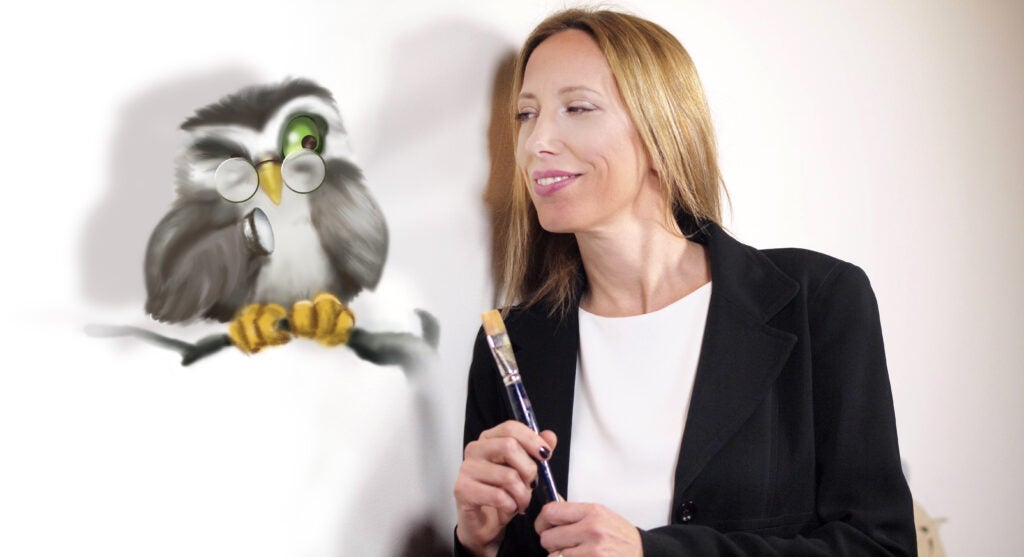
Gioti, a Greek author and illustrator, creates stories that spark children’s imagination and curiosity through art and storytelling.
Creative work is necessarily personal and emotional. How do you maintain a clear-eyed vision about the business and brand side of things?
Consistency is difficult. When creating for other brands, success relies on understanding the brand and using your skills to tell its story. Managing your own personal brand is different because it’s deeply personal — you put your truth out there and hope it resonates with your audience. When you stay true to your values, ideas, and purpose, consistency follows naturally.
You are both an author and illustrator. How do those two parts of your brain negotiate?
Negotiate is a perfect word. I call it a conversation between the writer and the illustrator in my head. In children’s books, text and images converse, and a stronger book emerges when this conversation is entirely collaborative. Some writer-illustrator duos achieve this over years of working together, but it’s more challenging. In my books, I have the freedom to add or subtract text, or adjust images, to ensure that the dialogue between words and pictures is never redundant or boring.
You have a busy public schedule, be it a library reading, school events, or teachers’ seminars. Does that connection to your audience give you an advantage as a writer?
Absolutely. Many of my ideas come directly from my audience. A word, concern, image, or thought shared with me during a school visit or seminar can spark a new book. Understanding children, parents, and teachers, and seeing their challenges firsthand, helps me create stories that truly resonate.
You offer educational materials for teachers that accompany your books. What has the reaction been from teachers and students?
Through the educational materials, we aim to help teachers make the reading experience more interactive and multi-dimensional. The story and characters serve as a starting point for fun mental strength activities. Children enjoy the experience through play, understand the underlying lessons, and develop a stronger connection to books in general. Teachers appreciate having creative ways to address important topics and facilitate discussion in the classroom. It’s designed to be a fun process that engages children and encourages a love of reading.
All my characters have a little piece of me.
You’ve expanded your books into games based on developmental best practices. How does gamifying a story change the way a child internalizes the lesson?
Gamifying a story makes learning active and engaging. Children become participants rather than passive listeners. This hands-on approach allows them to experiment with consequences, practice problem-solving, and see the results of their decisions in a safe environment. By connecting lessons to actions and rewards, gamification strengthens memory, encourages reflection, and makes abstract concepts like resilience, empathy, or responsibility feel tangible and relevant.
The books have created momentum and a movement of sorts. What is the impact you want to have?
I am thrilled by the impact my books have on children, parents, and teachers, and the fact that they are used in schools around the world. I receive messages every day describing how my books have helped children and transformed entire families’ perspectives on mental strength.
Looking ahead, I want to provide even more tools and ideas for children to cultivate a helpful inner voice. This includes collaborations with major stakeholders such as Sony Music, which recently announced the album, Yeti: The Power of Yet, at a major event in Athens. A licensing deal is already bringing a new children’s mental strength product line into bookstores, a play is in production, and a new book for children 8 and older is about to be released from my Greek publisher, Dioptra Publishing. Meanwhile, we are negotiating translations of my books worldwide — not yet in English, but hopefully soon.
CRAFTWORK — Gioti Takes Us Inside Her Creative Process
How and where do you like to write?
There is a special connection between our minds and our hands, so everything starts in a little notebook where I sketch my ideas. I carry it with me everywhere. After the idea, the plot, and the first sketches of the characters and the layout of the book are formed, I move to digital. Nowadays, it is much easier to draw on a Wacom tablet or iPad. It gives you a lot of freedom and flexibility to use your illustrations across different mediums.
How do you cure writer’s block?
By experiencing and learning new things. I read, I travel, I go to the theater, I visit classrooms, and I become curious about what might make children’s lives better or what new things are happening in education. I keep my antennas open, and at some point, something gives me an idea for a new book. Living in a vacuum has never helped creativity.
What advice do you give to aspiring writers?
Stop putting your dreams in a drawer and start today. Finish the book you’ve always wanted to write, even if it’s not perfect. Do something with it. Test the waters and try again. Strive to improve every time. Put yourself out there. And read. Read a lot. The best way to learn to write well is to read books. Because when the time comes to write, you have learned from the best.
This story was originally featured in the Georgetown Business Spring/Summer 2026 Magazine.