Bridging Worlds Through Business: My Global Business Experience in Kenya
This story is part of the Student Voices series, which provides a firsthand perspective of the student experience at Georgetown McDonough.
Hadi Uppal (MBA‘25) recently traveled to Kenya as part of Georgetown McDonough’s Global Business Experience. Here, Uppal shares how the experience enhanced his perspective of global business and the key lessons he plans to carry with him throughout his career.
My Path to Georgetown
I began my career as a consultant after earning a degree in computer science from Rutgers University. I was always drawn to solving complex business challenges while working alongside diverse, cross-functional teams. That interest eventually led me to Deloitte, where I contributed to several large-scale transformation projects. A common thread across these engagements was collaboration with teams across Western Europe, Latin America, and Asia. That global exposure became one of the most rewarding aspects of my work and something I wanted to develop further.
Looking ahead, I wanted to focus on broader strategic and cross-border issues that impact business, government, and society. Pursuing an MBA felt like the natural next step. I specifically sought a program that would offer new opportunities to engage in global business within a diverse, interdisciplinary setting.
That search brought me to Georgetown McDonough, which I chose for several reasons. Its Washington, D.C. location offers unparalleled access to opportunities at the intersection of business, policy, and international affairs. The university’s global reputation and strong alumni network gave me confidence that I would be supported throughout my career. Lastly, the collaborative student culture, ability to take courses across Georgetown’s schools, and hands-on experiences, such as the Global Business Experience (GBE), made it clear that I could shape a truly global MBA journey.
The GBE: Choosing Kenya
The GBE is one of the hallmarks of the Georgetown MBA; it brings together classroom learning and team collaboration to solve a real-world problem. When selecting a project, I wanted to go somewhere I had never been before, and work on a challenge outside my prior experience.
The projects based in Nairobi immediately stood out. I had never traveled to or worked anywhere in Africa, and I felt that the opportunity to immerse myself in Kenya would offer strong personal and professional growth. I was especially drawn to a project with CrossBoundary Group, an investment firm that unlocks capital for sustainable growth in underserved markets. They had launched CrossBoundary Access, an investment fund for solar mini-grid projects, and wanted to assess the market feasibility for investments in Zambia and the Democratic Republic of Congo (DRC).
This aligned with my growing interest in clean energy and investing in emerging markets. In the spring semester, I was also set to take an elective at Georgetown’s School of Foreign Service on Clean Energy Investing in Developing Economies with Professor Migara Jayawardena, and this project felt like a great way to apply course learnings in a real-world context.
The Project: Building for Impact
Our team began working two months before traveling to Kenya. Under the guidance of Professor Anthony Annan, we conducted detailed market assessments of Zambia and the DRC and reviewed our progress with the CrossBoundary team. Professor Annan’s investment experience across Africa was invaluable in helping us refine our approach and recommendations.
What stood out was how naturally our team aligned on roles. Each of us leaned into our strengths, whether in financial modeling, project management, or presentation design, while also gaining new skills along the way. I deepened my ability to conduct macroeconomic and sector analysis, and gained insight into what makes solar mini-grid investments feasible.
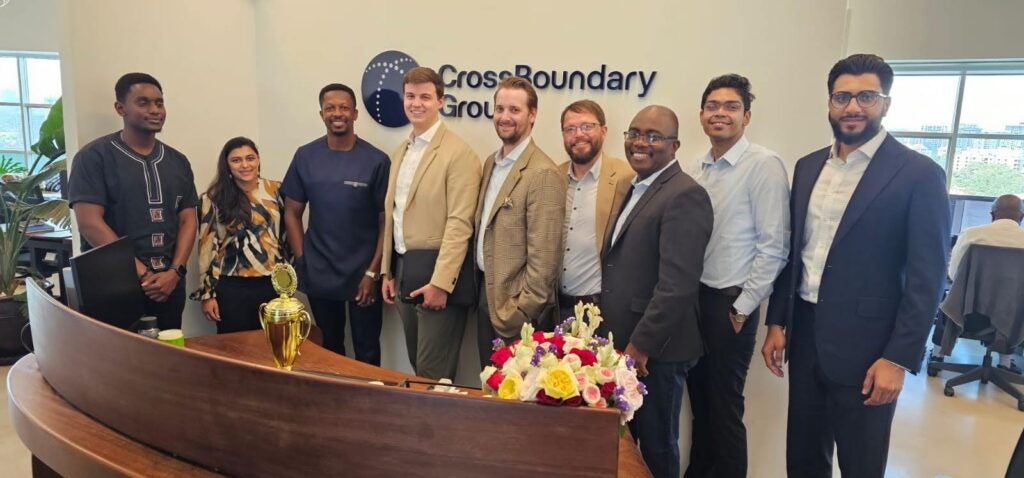
After we arrived in Nairobi and delivered our final recommendations to the CrossBoundary team, it was incredibly fulfilling to see how our efforts supported their mission to bring electricity to underserved communities across Africa. Their office was a hub of international collaboration, filled with professionals from across Africa and beyond, which demonstrated Nairobi’s status as a strong investment and business center for the region.
Beyond the Boardroom: Immersion in Kenya
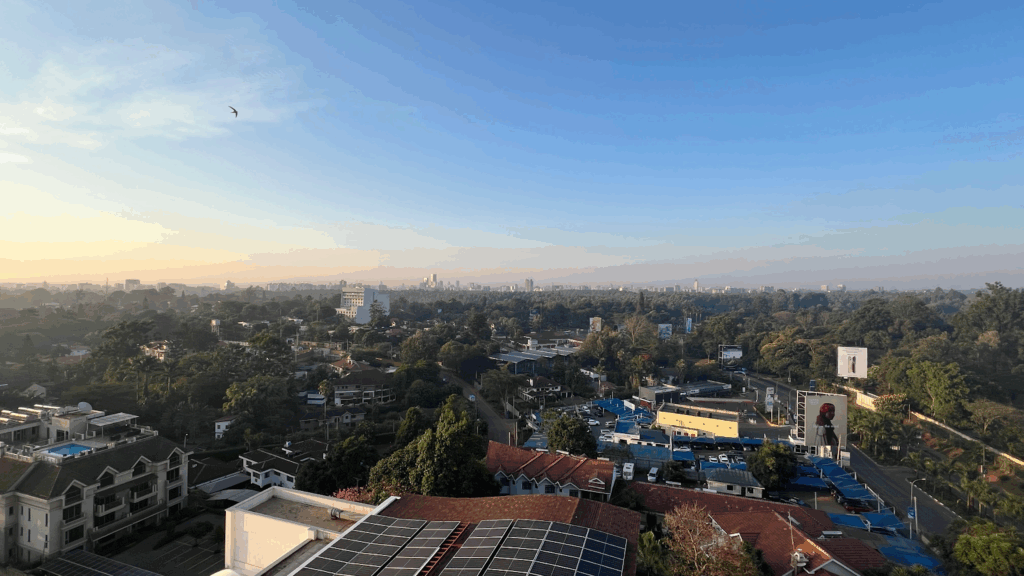
What made the GBE truly unforgettable was the local immersion organized by Kelly McGrath from McDonough’s Global Operations team. The rooftop view from our hotel revealed lush greenery in every direction, something I had not expected from a major city in a developing country. Next door was the Karura Forest, one of the largest urban forests in the world.
On our first day, we visited Nairobi National Park; seeing giraffes and rhinos with the city skyline as a backdrop was surreal. Driving through the savannah, I was struck by the vastness and beauty of the landscape. It stretched far beyond what I could see, yet it represented just a fraction of the continent, and an even smaller part of the planet. It was a humbling reminder of the scale of our world, how intricately life is sustained across it, and how intertwined we are with our environments. This highlights our shared responsibility to care for the planet and consider how our actions impact the future for everyone who depends on it.
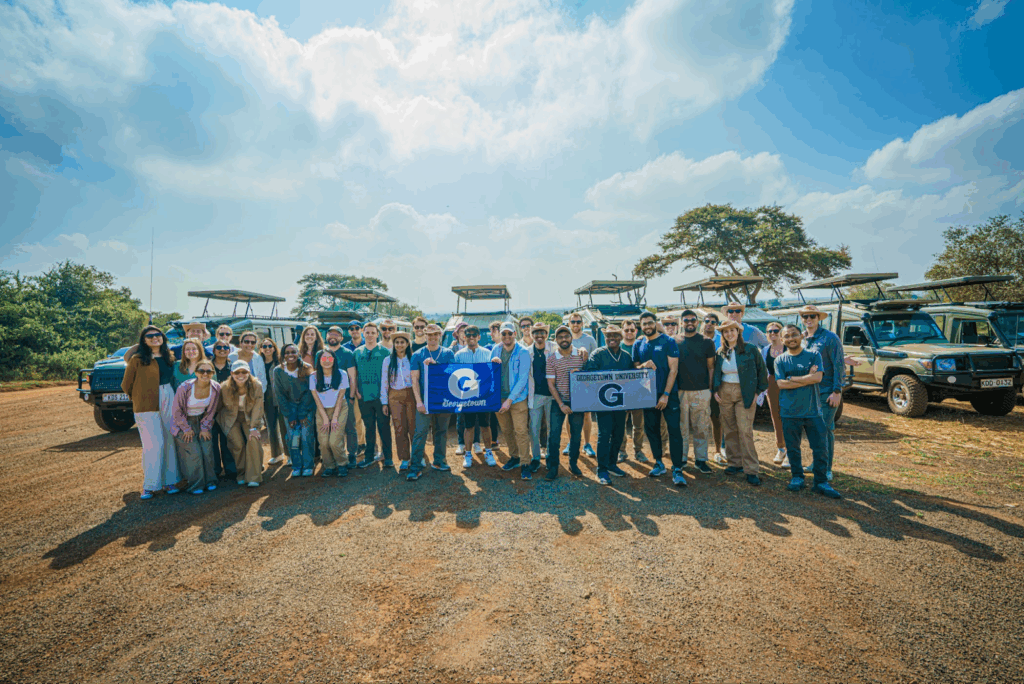
Later in the week, we toured a coffee and tea farm. Our guide, who had studied physics at university, exemplified the talent and potential present in Kenya.
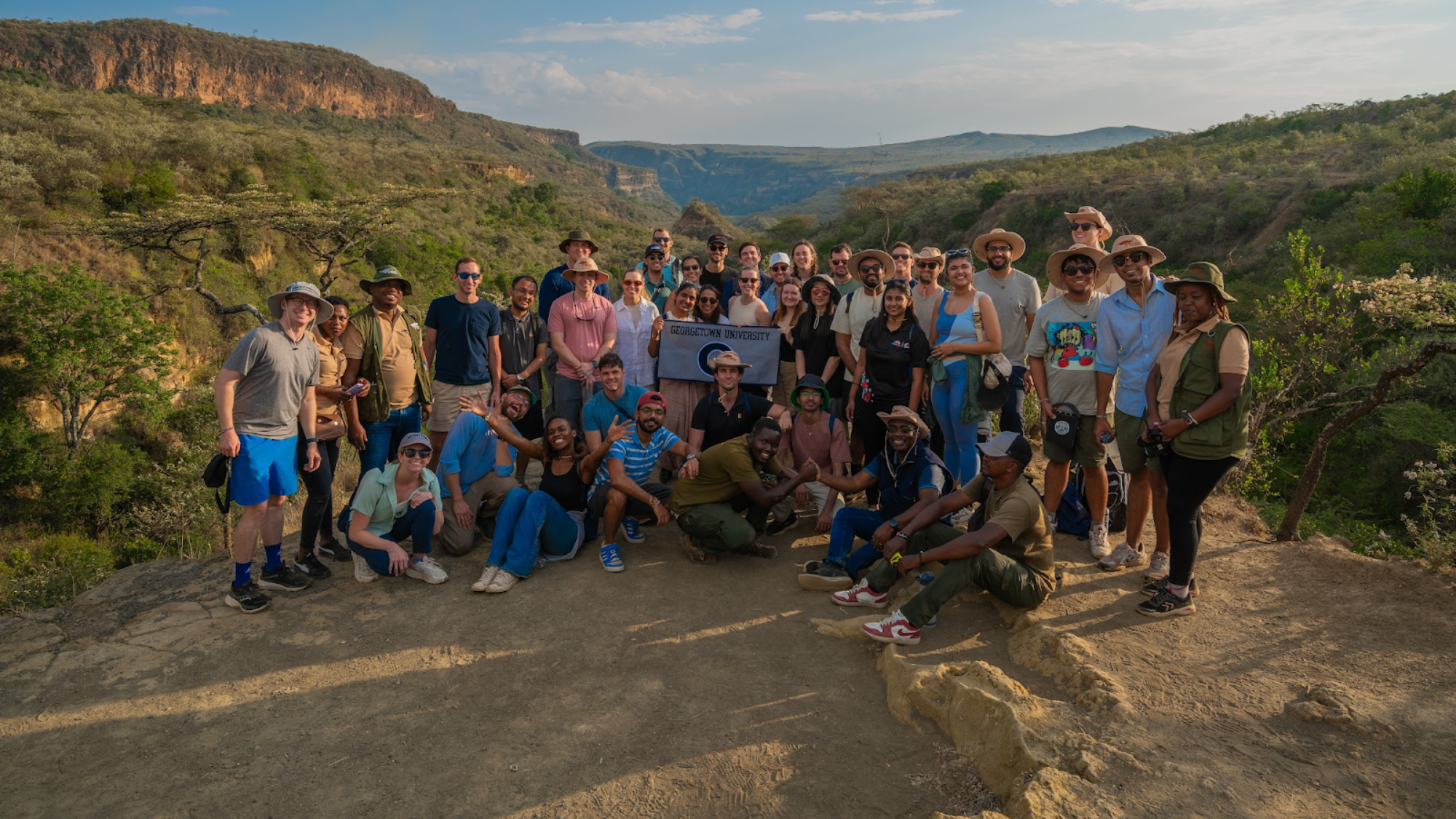
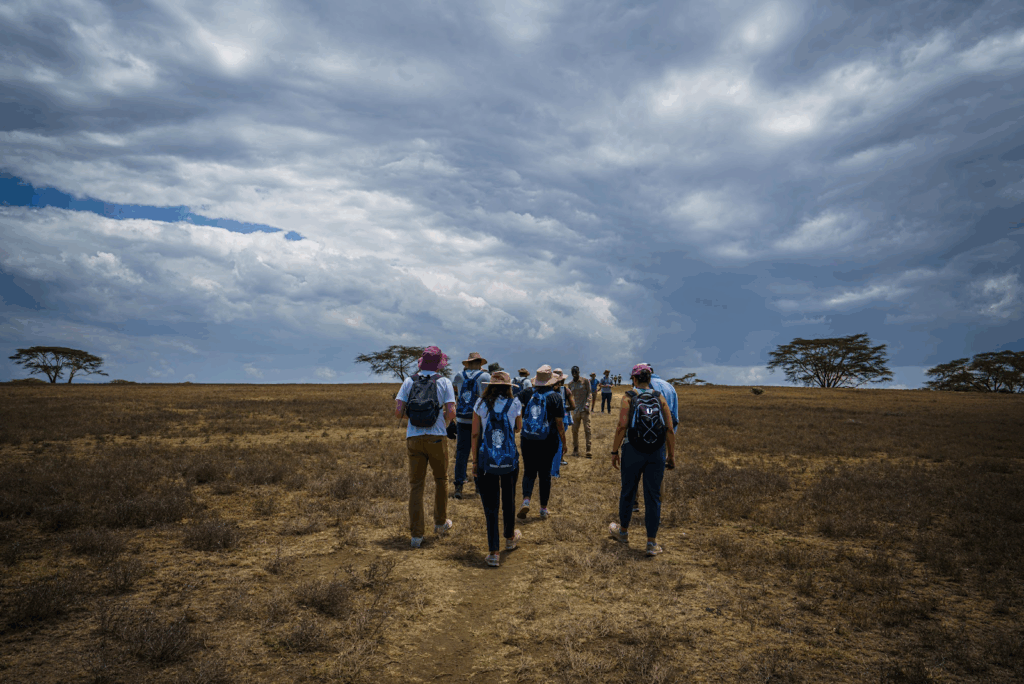
We ended our trip with a boat ride on Lake Naivasha, a drive through Hell’s Gate National Park, and a hike through its gorges. We also walked among wildlife at Crescent Island Game Sanctuary, which brought us face to face with nature in an unforgettable way.
Where Personal Meets Global
Ramadan happened to fall during our trip, and one of the most meaningful moments for me was attending evening prayers at the Jamia Mosque in downtown Nairobi. There is something powerful about stepping into a house of worship halfway across the world and still feeling that deep sense of unity and belonging. It was a moment of spiritual grounding amidst the excitement of travel.
On my final day in Kenya, I also met my father’s first cousin for the very first time, someone he had only ever spoken to on the phone. Sitting with her and her family and sharing stories reminded me that the enduring bonds of family can rise above distance and time. I thought of my grandmother, Bilquis, and how meaningful it would have been for her to see that connection come to life in Kenya, something that was undoubtedly made possible by Georgetown and the GBE.
Advice to Future MBA Students
To close out our trip, I traveled to Egypt to visit another McDonough classmate while others ventured to Kilimanjaro, Bali, and the Masai Mara. We were scattered across the globe, all making the most of one of the last opportunities to travel together before graduation.
If I could offer advice to future students as they think about GBE, it would be this:
- Choose a project and destination that stretches you. Go somewhere unfamiliar and work on something new that still allows you to contribute meaningfully.
- Get organized early. Set clear milestones with your team and take full advantage of the early GBE structure.
- Embrace the cultural immersion. Visit local markets, attend events, and connect with people on the ground. That is where the real learning happens.
One day, I hope to return to Kenya, not only to visit the Masai Mara, but to continue deepening the family ties that were rekindled during this trip. The GBE gave me the chance to explore a new region, dive deeper into a new topic, and create lasting memories with classmates and family. For that, I will be forever grateful for my time at Georgetown.
-Hadi Uppal (MBA‘25)