This story is part of the Student Voices series, which provides a firsthand perspective of the student experience at Georgetown McDonough.
During a career trek to San Francisco over spring break, Myiesha Permana (B’28) and her classmates explored one of the world’s leading hubs for technology innovation. Through company visits ranging from global tech giants to early-stage startups, the experience offered an unfiltered look at how artificial intelligence is shaping industries, careers, and everyday life.
Here, Permana reflects on moments that challenged initial assumptions about AI — and the unexpected sense of clarity gained from seeing firsthand the people, ideas, and humanity driving its rapid evolution.
First Impressions in the AI Epicenter
One moment, I found myself taking a tour through the endless floors of Airbnb, going from a ramen bar to Australia and then to Brazil — meeting rooms modeled after eccentric locations or themed countries and cities. The next moment, I was squished against my peers in the living room of a one bathroom-bedroom apartment decorated solely with PC-topped desks (Claude Code pulled up, of course), and tiptoed so I could properly listen to the 20-something-year-old innovators sitting in the chairs accompanying said desks. During both moments, I felt an overwhelming sense of relief in my heart.
Instead of returning to my home state of Arkansas over spring break, I decided to travel to the opposite coast for an AI-focused trek in the Bay Area, hosted by Georgetown McDonough. Admittedly, I was excitedly envisioning days sunbathing in sight of the Golden Gate Bridge and food-crawling through Chinatown. But most importantly, I was also questioning: How much progress is AI making? Is it taking over potential jobs? Is there more than meets the eye?
Once we landed and were driving towards our hotel, similar to pop-up ads that flood one’s screen after obtaining a virus, each billboard we passed by force-fed us glorious promises of efficiency, agents, and superhuman AI. Even for anyone who accepts this new age of AI, it was overwhelming. I was listening to my peers read aloud the short phrases meant to catch the fleeting attention of drivers, who were also taken aback by the sheer amount of advertisements. Yet, although I was fearful of how prominent AI and technology seemed to be in San Francisco, which contrasted heavily with the political atmosphere of D.C., I kept my mind open.
A Birthday Party for a Robot
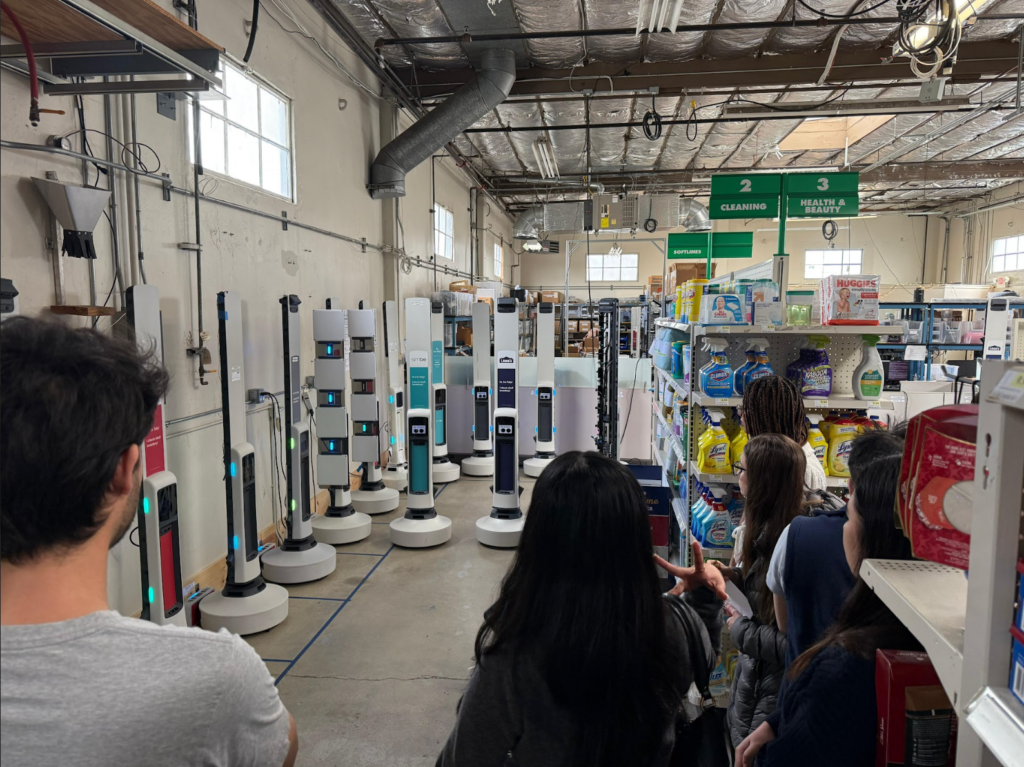
It was a birthday party that first began to change that. At Simbe Robotics, listening to them discuss their product — Tally, a friendly human-like robot that categorizes stock amongst other things — and the grocery stores they are deployed in, I was struck by an offhand mention: one of the stores hosts a birthday party to celebrate the robot each year, a testament to how much it means to them. This was a reminder to me of the core purpose of evolving technology: to support and supplement our projects and processes, not replace them. I realized AI was just another iteration of that same idea, albeit unbelievably more advanced than anything ever seen before.
At Simbe Robotics, they showed us different iterations of Tally. Over time, they improved the design to be more human-like and approachable.
That foundation only grew. At REC, a startup working to get citizens easier access to recreational parks, fields, and equipment, the resident office dog could not distract me from the self-starting, inspiring energy of co-founder Rachel Williams and a few members from her team, who spoke to us eagerly about negotiating with recreational committees across states all over the country. In the current age – when it feels like every mundane, everyday problem has already been solved and pitched and turned into an app or a service – to see brand new ideas continue to be born inspired us. They were young and very “boots on the ground,” nothing like the established companies we’d visited, but exuded that same organization and passion regardless. If Simbe showed me what technology could mean to people, REC reminded me that the most human problems were still waiting to be solved by human hands.
This was a reminder to me of the core purpose of evolving technology: to support and supplement our projects and processes, not replace them.
The Perks of Big Tech
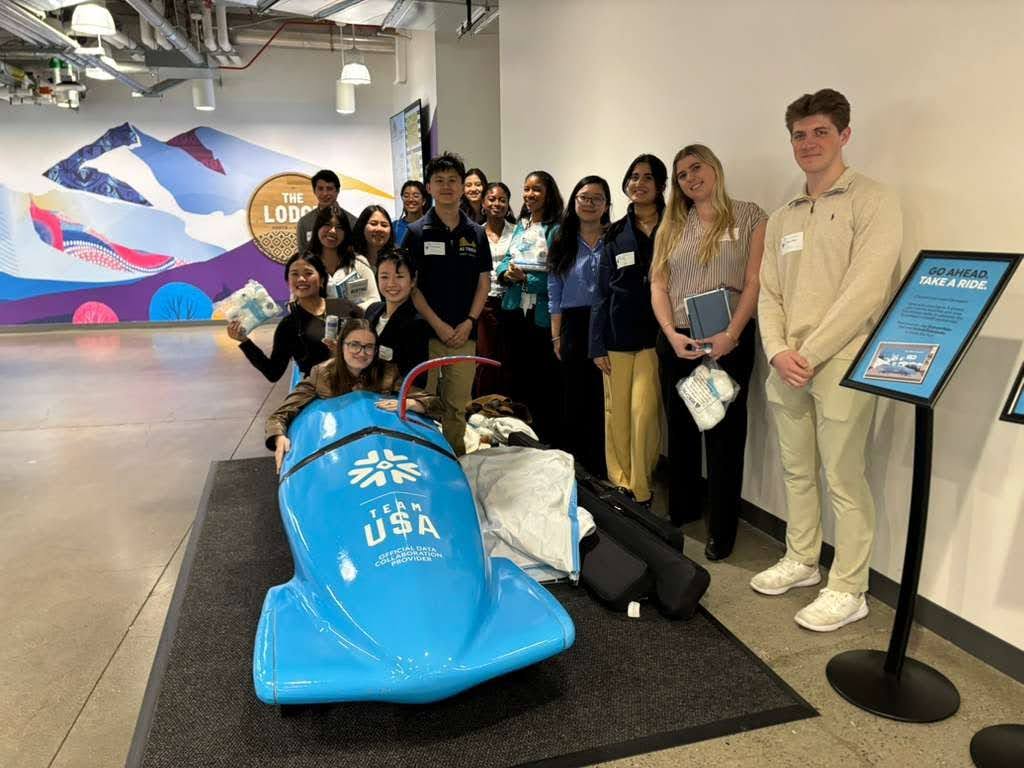
We couldn’t have gone the entire trip without experiencing a taste of the luxuries such tech companies have. At Snowflake, with balsamic vinaigrette-feta cheese-caramelized onion pizza in one hand and a cold bottle of jasmine tea in the other, my friends and I ate together on a balcony overlooking Silicon Valley. We’d finish listening to Denise Persson, chief marketing officer, discuss the growth she’d witnessed during her time at the company and how much everything had changed. When we came back inside, safe from the chilly breeze of the Bay, we were gifted with books detailing her expertise and an adorable plushie of Snowflake’s mascot, a bear. Times like these made the world of tech very alluring, and many of us began to actually consider pursuing this path.
Snowflake was a provider of the 2026 Winter Olympics, and here we are posed with a special Snowflake-branded bobsleigh, holding our lovely gift!
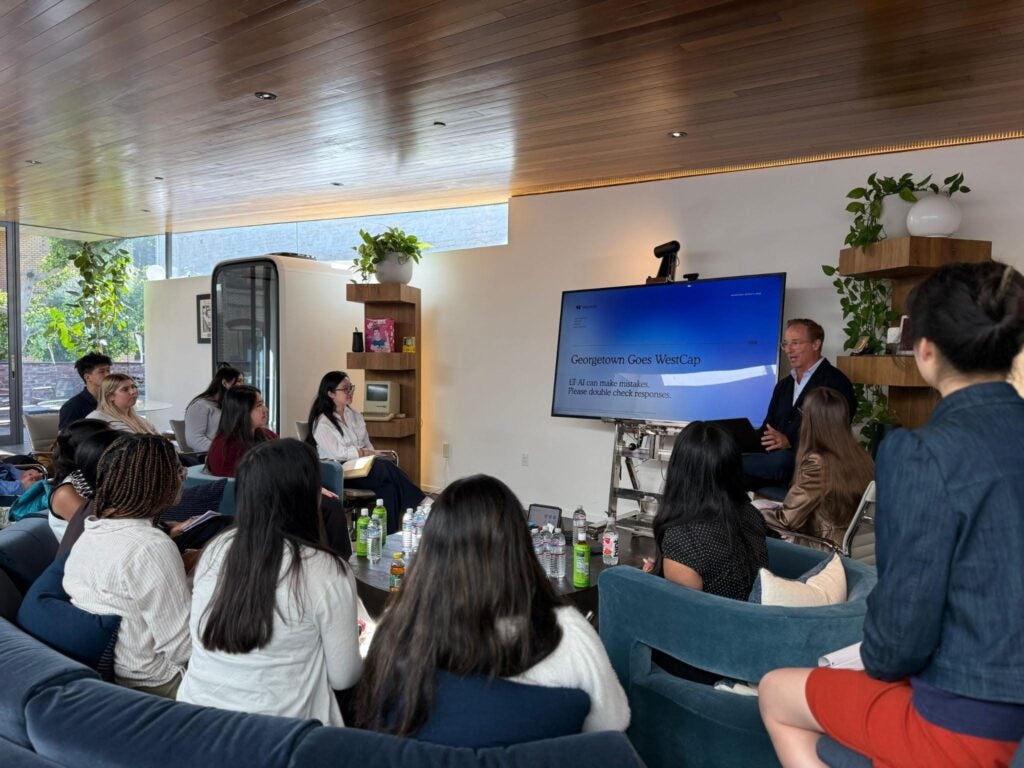
Then, it was a fellow Hoya that brought us back to Earth. Laurence Tosi (MBA’94), CEO of Westcap, a growth equity firm, and a triple threat with an undergrad, MBA, and JD, marveled at our journals and our lack of laptops, instilling in us an urgency about how much of our lives and futures reside in our devices. His presentation laid out the different tiers of AI adoption plainly and without comfort: companies and roles not keeping pace risked being left behind. It wasn’t entirely informational; he bonded with us over the dreadful hills of the Hilltop, a moment where he realized he had to drag his luggage all the way to Darnell.
Tosi provided a different perspective to the AI landscape, and we got to see his cozy office, where he and his teams have spent many hours working through projects. The computer on the shelf was actually his personal computer during his time at Georgetown!
Different Paths, Same Drive
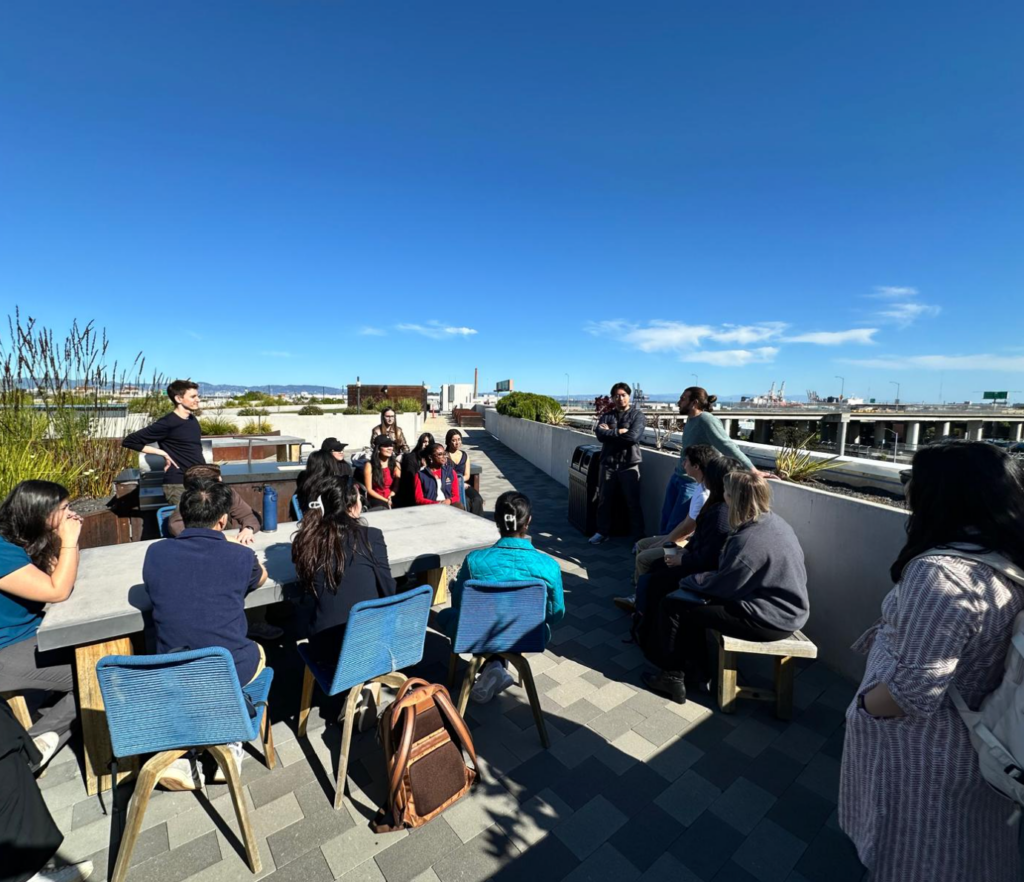
By the end of the week, I found myself in one moment on the endless themed floors of Airbnb, and the next, the one-bedroom apartment of Halluminate, with Claude Code pulled up on every screen. In the ride leaving the second company, amongst talks of the night’s Chinese Lunar New Year parade and Waymo learning to be more aggressive (they can honk!), we remarked on the stark difference between the two companies. Despite the disparity, we were surrounded by people building things that didn’t exist yet with the same undercurrent of passion and dedication to contributing to the world. I felt relief.
We were surrounded by people building things that didn’t exist yet with the same undercurrent of passion and dedication to contributing to the world.
Halluminate’s co-founders chatting with us about their journey on their complex’s beautiful rooftop view.
I came out of this trip with newfound excitement. It is true that AI is increasingly prominent in all workflows and will continue to take over many existing processes. Every company we visited, small and large, emphasized the importance of learning the language of AI, practicing it, and integrating it wisely into our personal work and lives.
Although the purpose of the trek was to educate us on the sometimes-threatening role of AI in business, I instead discovered the very-much-alive sense of humanity that persists, in a grocery store birthday party for a robot, in a founder negotiating for public green space, in connecting with a Hoya who reminisced about his time in Darnell. I am ultimately grateful to Georgetown McDonough for putting AI into perspective, and for the stunning landscapes and oh-so-delicious cuisines of San Francisco along the way.