About MSB

Bookmark and Share

At a Glance

The Robert Emmett McDonough School of Business educates future business leaders of the highest ability, integrity and commitment to improve the world. Faculty foster a learning environment based on teaching and research that challenge students to take an active role in the education process. The school is committed to developing leaders capable of making complex business decisions in a global environment and who are dedicated to serving their companies, society and humanity.

Dean
George Daly

Students
A total of 1,354 undergraduate students and 979 graduate students were enrolled in 2009, including 502 MBA Full-Time students, 342 MBA Evening Program students, 90 Georgetown Campus Global Executive MBA students, 29 Georgetown-ESADE Global Executive MBA students, and 16 Executive Master’s in Leadership students.

Faculty
The McDonough School has 93 full-time and 34 adjunct professors teaching in the fall of 2009.

Degree-Granting Programs
• Bachelor of Science in Business Administration
• Master of Business Administration, full time and evening
• Global Executive MBA - Georgetown Campus
• Georgetown-ESADE (Spain) Global Executive MBA
• Executive Master’s in Leadership

The school awarded 324 undergraduate degrees, 345 MBA degrees, 51 Global Executive MBA – Georgetown Campus degrees, 31 Georgetown-ESADE Global Executive MBA degrees, and 27 Executive Master’s in Leadership degrees in 2009.

Curriculum Highlights
Georgetown’s McDonough School of Business is known for its interdisciplinary focus in finance, international business, and public policy. Core courses in the traditional disciplines of accounting, finance, marketing, management, operations and information management, ethics, and decision sciences support these areas of focus. Interwoven into the curriculum are classes on leadership.

Distinctive Programs, Research Institutes, and Initiatives
• The Global Capital Markets Research Center supports research, teaching, and public dialogue on issues related to domestic and global capital markets. In the wake of the financial crisis and following a decades-long period in which innovation and globalization profoundly transformed financial markets, Washington has become a de facto center for global capital markets. Established in 1988, the center fosters thoughtful and non-partisan discussion of issues related to global capital markets through programs for students, faculty, and leading participants from the private sector and the government.
• The Center for Business and Public Policy engages scholars, business people, and policy-makers in dialogue to make an impact on key business, economic, and public policy issues confronting U.S. and international businesses today.
• The Georgetown Women’s Leadership Initiative provides a forum for dialogue, the dissemination of knowledge and best practices, and skill-building for female leaders.

Rankings
U.S. News & World Report ranked McDonough’s MBA program No. 19 in the country in its “America’s Best Graduate Schools 2010.”
Business Week ranked Georgetown’s undergraduate business programs No. 24 and the executive MBA program No. 12 in 2009.
Fortune magazine ranked McDonough No. 16 in its “50 Best Business Schools for Getting Hired 2007.”
• The Financial Times in 2009 ranked McDonough’s full-time program No. 18 in the United States.

Student Outcomes
According to recent surveys of McDonough School of Business graduates, the four most common career fields upon graduation from the undergraduate program are:
• Consumer and investment banking
• Accounting
• Consulting
• Marketing

Noteworthy Facilities
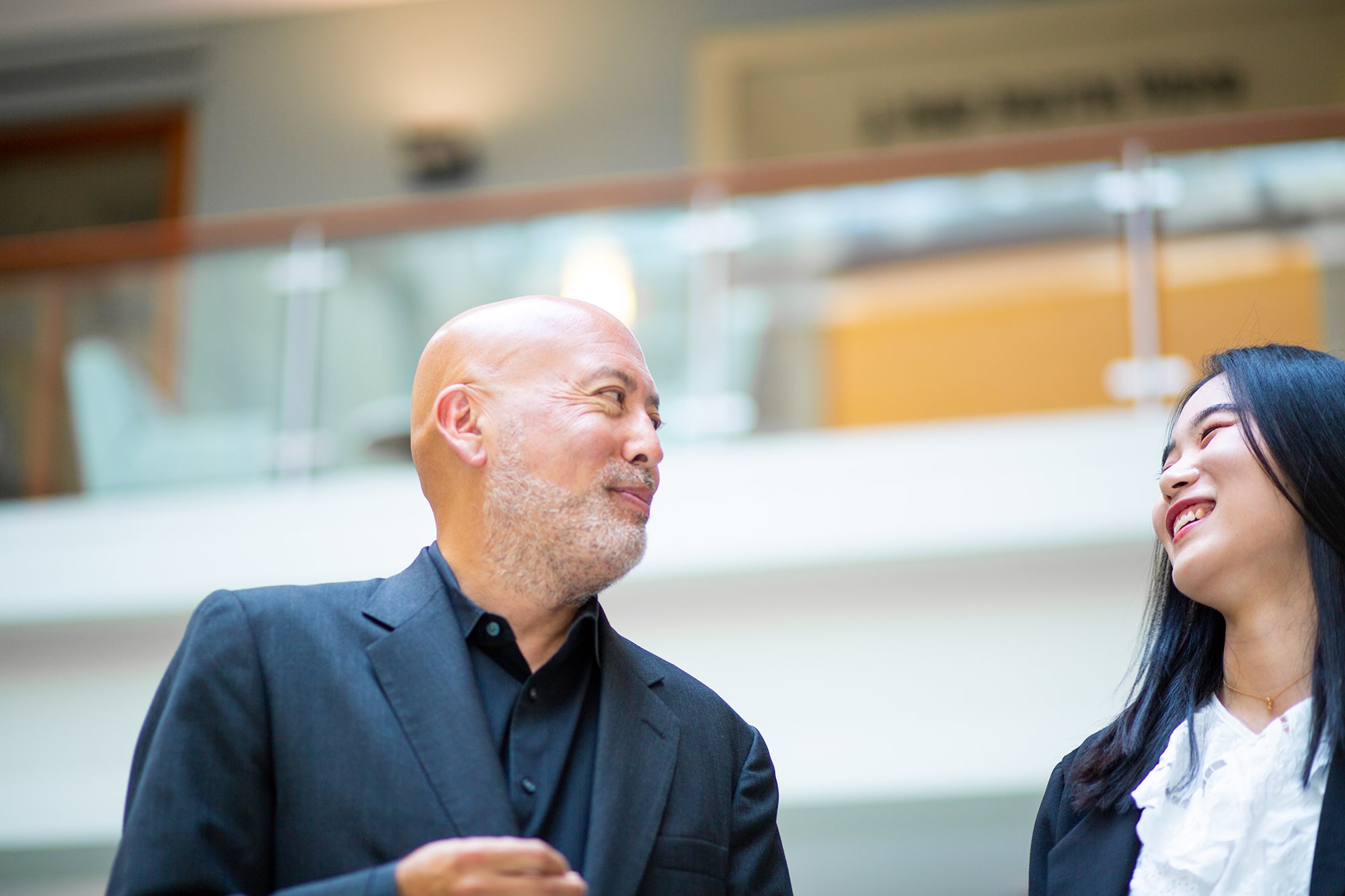
The 179,000 square foot Rafik B. Hariri Building houses all aspects of the business program at Georgetown University under one roof. It opened to all students in the fall of 2009 and features 15 classrooms, 34 breakout rooms, 15 conference rooms, 11 interview rooms, a 400-seat auditorium, two large lounges, and 120 faculty offices. Student space is replete with data ports, flat-screen monitors, and videoconferencing capabilities, allowing for global connectivity.

The abundant aesthetics of the building include a blend of stone masonry and steel on the south elevation reminiscent of the university’s original architecture combined with a panoramic glass pavilion on the east elevation. Together these designs symbolize the mix of traditional business foundations and forethought apparent in the education offered at Georgetown’s McDonough School of Business. A soaring glass atrium serves as the core new building, providing literal transparency of students’ education—putting business on display.