Learning to Lead Through Discovery: Undergraduate Research at McDonough
At Georgetown’s McDonough School of Business, undergraduate students can go beyond the classroom to cultivate critical thinking, dive deep into data, and address real-world challenges through a range of research opportunities. Through sustained inquiry and close faculty mentorship, students engage complex questions, develop analytical rigor, and apply their learning to real-world challenges.
Rooted in the school’s mission to educate principled leaders, these experiences emphasize reflection, sound judgment, and a commitment to contributing meaningfully to business and society. Students are encouraged to move beyond surface-level understanding, learning to evaluate evidence, navigate uncertainty, and approach problems with intellectual discipline.
“Research is one of the most powerful ways our students learn to navigate complexity,” said Patricia Grant, senior associate dean of Undergraduate Programs. “What distinguishes McDonough students is not just analytical skill but the ability to frame problems, interrogate assumptions, and use evidence to guide judgment. That is foundational to leadership in today’s global business environment.”
Undergraduate research at McDonough is supported through a range of distinct opportunities that allow students to engage in inquiry at different points in their academic journey. Whether working alongside faculty, pursuing an independent project, or undertaking a sustained research study, students develop the capacity to ask more precise questions, test assumptions, and generate insights that inform decision-making.
Three programs anchor this experience: Mentored Opportunities for Research Excellence (MORE), the Summer Undergraduate Research Fellowship (SURF), and the Senior Honors Thesis. Each offers a different approach to research, together reflecting McDonough’s commitment to developing students’ analytical rigor and capacity for thoughtful, evidence-based inquiry.
Building Research Foundations Through MORE
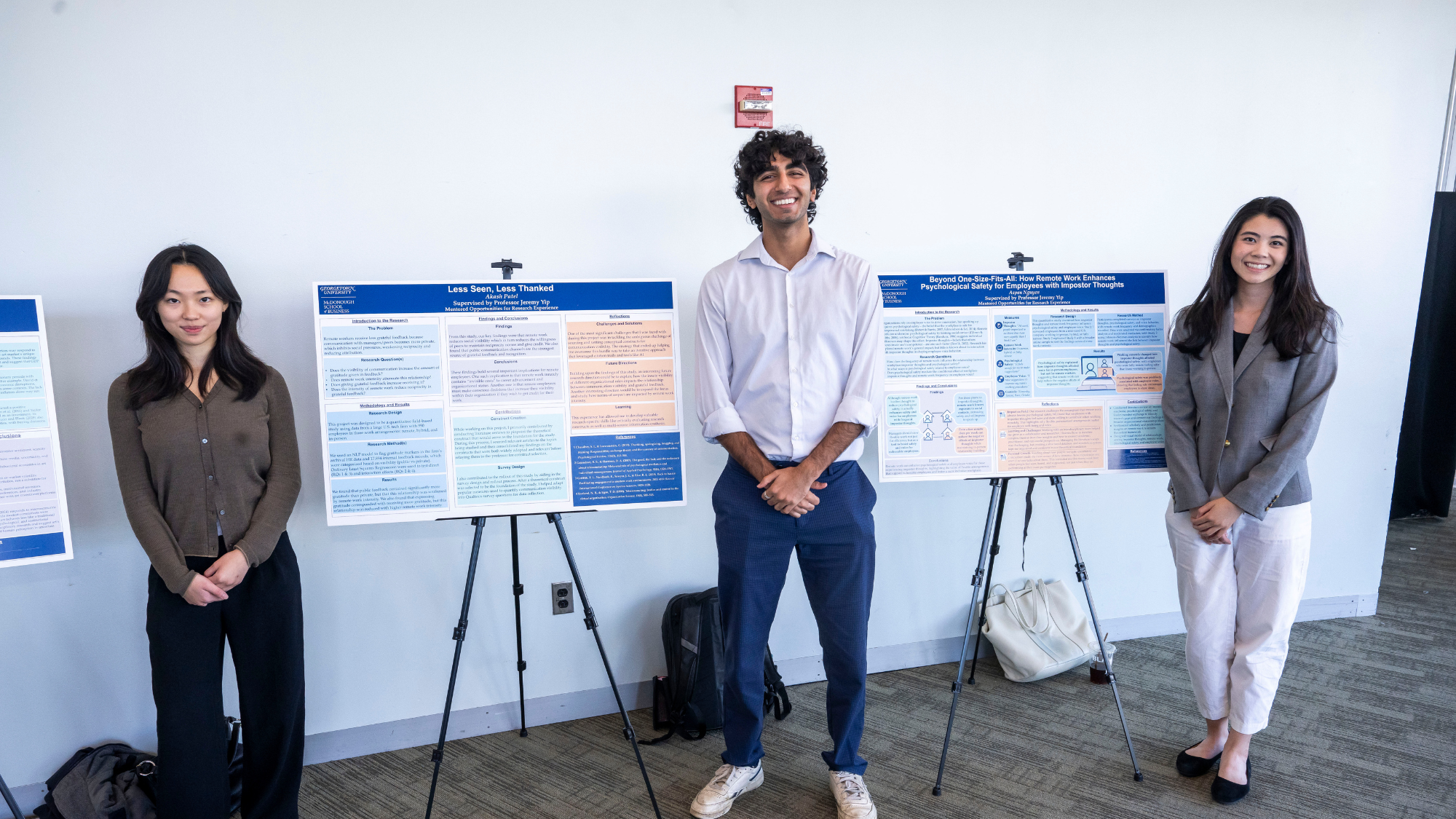
The Mentored Opportunities for Research Excellence (MORE) program introduces students to the practice of research through direct collaboration with faculty on ongoing projects.
In this setting, students gain insight into how research questions are developed, refined, and tested in practice, contributing through activities such as data analysis, literature review, and early-stage idea development. They learn to work through ambiguity, recognizing that uncertainty is often an inherent and productive part of the process. Close mentorship allows students to build both technical skills and confidence in their ability to contribute meaningfully to academic inquiry.
“MORE is often where students first realize they can do research,” said Justin Smith, associate dean of strategic initiatives and program development. “It provides a hands-on introduction to asking questions, working through ambiguity, and developing ideas over time. Students come away not only with new skills, but with a stronger sense of ownership over their learning.”
At the conclusion of the program, students present their work at the McDonough Undergraduate Research Symposium, reflecting on both their findings and the process behind them.
Applying Research to Real-World Questions Through SURF
The Summer Undergraduate Research Fellowship (SURF) builds on this foundation by giving students the opportunity to design and execute independent, faculty-mentored research projects.
Working full-time over the summer, students explore topics ranging from financial markets and consumer behavior to sustainability, artificial intelligence, and global business. The experience requires sustained analytical focus, as well as the ability to interpret data and draw meaningful conclusions.
“SURF gives students the space to fully immerse themselves in a question they care about,” said Smith. “Through that process, they deepen their understanding of how knowledge is created and develop confidence in their ability to contribute to it.”
Sophomore Gianna Yerkes (B’28) participated in SURF to examine market trends and consumer preferences for protein-fortified foods not traditionally associated with high protein. Reflecting on the experience, she noted both the challenges and rewards of the research process.
“There were moments when I felt stuck, but that’s what made the experience so valuable,” said Yerkes. “I learned how to work through challenges, refine my thinking, and stay focused on the bigger question I was trying to answer.”
Embracing Inquiry Through the Senior Honors Thesis
In their final year, students may pursue a Senior Honors Thesis – the most advanced stage of undergraduate research at McDonough.
Over the course of an academic year, students develop and complete an original research project, working closely with faculty advisors. They define a focused question, design an appropriate methodology, and produce analysis that often draws from multiple disciplines, including economics, psychology, government, and international affairs.
The process requires not only research proficiency but also sustained focus, intellectual independence, and effective project management.
“This is what differentiates our students once they enter their careers,” said Smith. “They have the ability to approach problems critically, analyze them thoroughly, and continue asking thoughtful questions.”
Under the leadership of faculty director Jason Schloetzer, students have explored a wide range of topics, including corporate governance, stablecoin markets, media literacy, and organizational behavior. These projects provide an opportunity to engage deeply with a subject and to produce work that has lasting relevance.
“They will remember their topic and what they learned about it years from now,” said Schloetzer. “The ability to conduct meaningful research is valuable across industries and roles.”
Leaders Who Think Like Researchers
Taken together, these experiences represent a developmental pathway that shapes how McDonough students think and lead throughout their professional careers.
Rooted in Georgetown’s Jesuit tradition and strengthened by McDonough’s emphasis on applied, real-world business education, the undergraduate research experience produces graduates who can approach ambiguity with structure, challenge assumptions with evidence, and lead with clarity in complex environments.
“Through research, our students learn to take ownership of complex problems and see them through from question to conclusion,” said Patricia Grant, senior associate dean of Undergraduate Programs. “That experience builds a level of judgment, resilience, and clarity that sets them apart – preparing them to lead thoughtfully and communicate effectively in environments where the answers are not always clear. They don’t wait for answers; they know how to find them.”
- Tagged
- Undergraduate Programs